
Pigeon Control in St. George, UT: Why Pigeons Nest Under Solar Panels Every Fall
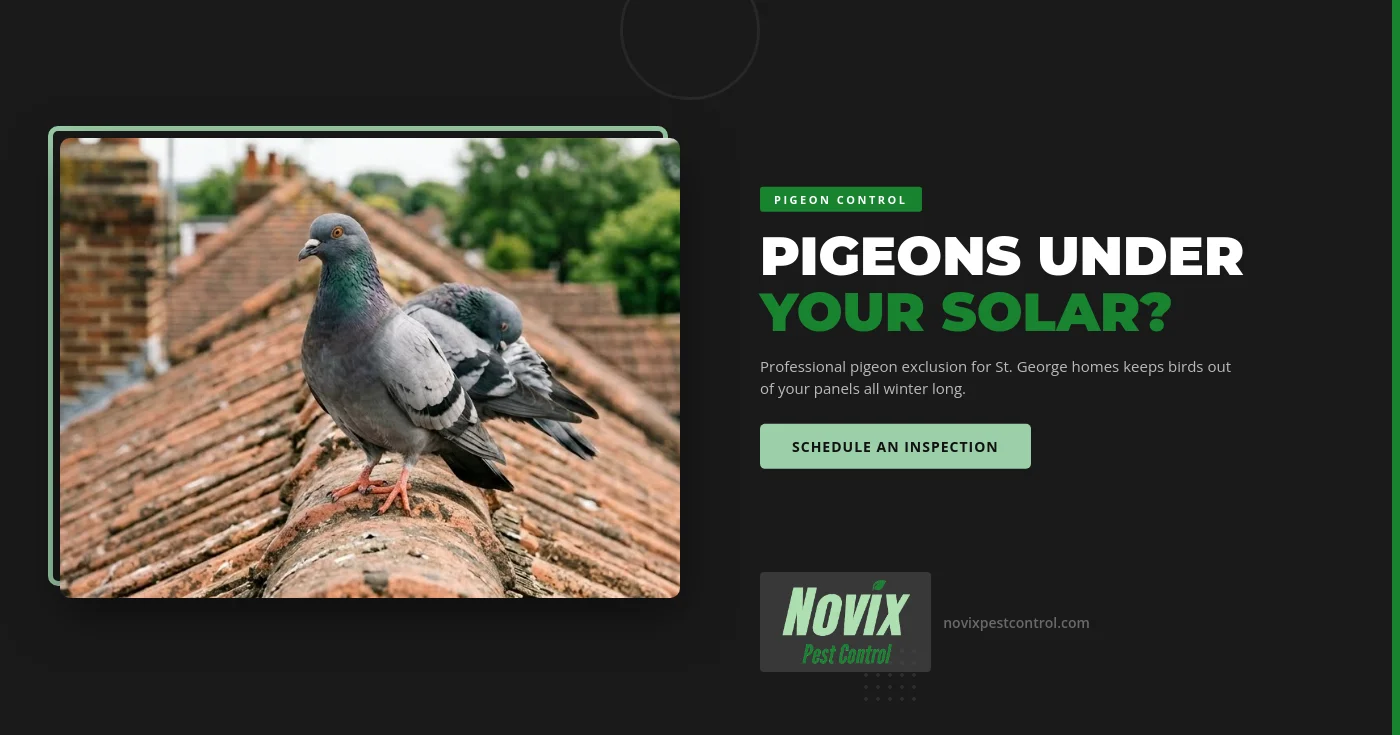
Pigeon Control in St. George, UT: Why Pigeons Nest Under Solar Panels Every Fall
Every October, homeowners across St. George start noticing the same signs. There’s soft cooing from the roof at dawn, feathers drifting off the eaves and a growing streak of droppings on the driveway below the solar array. Pigeons have found the warm, sheltered gap beneath the panels, and once they settle in, they rarely leave on their own. That’s why requests for professional pigeon control St. George service climb as fall temperatures drop.
Here at Novix Pest Control, we’ve been helping families in southern Utah protect their homes from birds, insects and rodents since 2010. Pigeons under solar panels are more than a nuisance. Their nests trap debris, and their droppings stain tile and stucco. A single pair can also raise several broods in a year if nothing changes.
In this guide, we cover why pigeons move onto rooftops and ledges in the fall and the warning signs to watch for. We also explain the damage they can cause, why store-bought deterrents often fall short and how professional solar panel bird exclusion keeps them out through winter.
Why Pigeons Seek Shelter on St. George Rooftops in October
Rock pigeons (Columba livia) descend from cliff-dwelling birds. To a pigeon, a roofline looks a lot like a rocky ledge. As October arrives, they start looking for shelter. In a typical year, daytime highs here begin in the low-to-mid 80s and slide into the 70s by the end of the month. Overnight lows can dip into the 40s and 50s. Those cooler nights push pigeons toward spots that block the wind and hold a little warmth.
The space beneath a rooftop solar array checks every box. It’s shaded, dry and out of the wind. The roof underneath often holds heat from the afternoon sun, and the tight gap keeps hawks and other predators from reaching the nest. This is how pigeons typically behave when they find a sheltered cavity, and it explains why so many of our fall calls involve solar panels.
Timing matters too. The Internet Center for Wildlife Damage Management’s overview of pigeon biology notes that pigeons can breed year-round in mild climates. They often lay two eggs per clutch and raise several broods each year. Eggs hatch in roughly 18 days, and young birds may leave the nest within about four to six weeks. Pigeons are also strongly loyal to their roosting and nesting sites. Our winters are mild, so a pair that settles in this fall may keep nesting straight through to spring. That makes fall the ideal window for pigeon nesting prevention.
Solar Panels, Tile Roofs, and Ledges: The Nesting Spots Pigeons Prefer
Pigeons look for three things: a flat or gently sloped surface, overhead cover and a predictable spot to return to every night. Many homes in our area offer all three in more than one place.
Under Solar Panels
The gap between the panels and the roof is usually just a few inches, which is exactly the kind of covered space pigeons like. Once one pair moves in, others often follow. Nesting material, feathers and droppings build up quickly where you can’t see them from the ground.
Concrete and Clay Tile Roofs
Tile roofs are common throughout the region. Their curved profiles, open ridge ends and gaps at the eaves give pigeons natural pockets for perching and nesting. Birds may also tuck in where tiles meet walls, chimneys or skylights.
Ledges, Parapets and Window Sills
Stucco ledges, decorative pop-outs, flat parapets, patio covers and window sills make ideal roosting perches. Business owners see the same pattern on storefront signs, loading docks and rooftop HVAC units. That’s why we also include bird work in our commercial pest control programs. In many cases, birds perch on ledges during the day and nest under the panels at night. Treating only one area tends to push them to the other.
Warning Signs of a Pigeon Problem Around Your Home
The nest is often hidden under the array, so many homeowners don’t realize how big the problem has become until the signs pile up. Watch for:
- Cooing and scratching from the roof, especially early in the morning and around dusk.
- Droppings on the driveway, patio, walkways, cars or the edges of the panels.
- Feathers and twigs poking out from beneath the panels or collecting in gutters.
- Birds flying in and out from under the array or lining up along the roof ridge.
- Clogged gutters or downspouts packed with nesting debris.
- Stained stucco or tile below favorite perches.
- A drop in solar output, which may mean droppings or debris are shading the panels.
If you notice two or more of these, pigeons have likely already set up a nesting site. A quick look from the ground with binoculars can often confirm activity without climbing onto the roof. One visible bird usually means more nearby, because pigeons tend to roost in groups. The sooner you act, the fewer birds and broods you’ll have to deal with, and the less cleanup your roof will need.
How Pigeon Droppings and Nests Damage Roofs, Panels, and Gutters
Pigeons cause more than a cosmetic mess. Over time, the damage adds up across several parts of your home.
Roofs and Finishes
Pigeon droppings are acidic. They can stain, etch and gradually wear down roofing materials, paint and stucco. On tile roofs, built-up droppings and nesting material can also hold moisture and block the channels water uses to drain.
Solar Panels and Gutters
Droppings on the glass and debris piled around the array can shade the cells and may reduce energy production. Nests beneath the panels also trap leaves, twigs and feathers around wiring and mounting hardware. Some people in the industry worry that debris near electrical components could be a fire risk. Authoritative data on this is limited, but it’s one more reason not to let nesting material build up. Debris also washes into gutters and downspouts, which can cause overflow during storms.
Health Concerns and Other Pests
According to the Centers for Disease Control and Prevention, the fungus behind histoplasmosis can grow in soil enriched with bird or bat droppings. Disturbing dried material can send spores into the air. For most healthy people the risk is generally low, but it rises when large piles are disturbed, so careful cleanup matters. Nesting areas can also attract mites and insects. Spilled seed and nesting clutter may draw in mice and rats, which our rodent control team also handles.
Why DIY Deterrents Often Fail Against Persistent Pigeons
Hardware stores are full of bird deterrents, and it’s natural to try one first. Pigeons are persistent, though, and most quick fixes don’t hold up.
- Plastic owls and hawks: Pigeons quickly learn that a decoy never moves. Many will perch right next to one within days.
- Reflective tape and spinners: These may startle birds at first, but the effect fades as pigeons get used to them.
- Spikes in the wrong places: Poorly placed or spaced spikes leave gaps, and pigeons sometimes build nests right on top of them.
- Removing nests without exclusion: Pigeons are loyal to their sites, so a cleared nest is often rebuilt in the same spot within days.
- Homemade mesh or netting: Birds can push through gaps at corners and seams. Materials attached the wrong way can also damage panels or roofing.
There are practical concerns as well. Working on a pitched tile roof is risky, and tiles crack easily underfoot. With some manufacturers, drilling into panels or frames may also void a solar warranty. Here at Novix Pest Control, we see many homes where well-meaning DIY efforts only moved the birds a few feet down the roofline.
How Professional Pigeon Control and Solar Panel Exclusion Work
Effective pigeon removal in St. George, UT, relies on exclusion, which means physically sealing off the spaces birds use. Scare tactics alone rarely last. Here at Novix Pest Control, our licensed and insured technicians follow a proven process:
- Inspection: We examine the solar array, roofline, tile edges, ledges and gutters. We identify every nesting and roosting site and how the birds are getting in.
- Nest and debris removal: We remove nests, feathers and debris from beneath the panels and around the roof, following applicable regulations.
- Cleaning and sanitizing: We clean and sanitize affected areas. This reduces odors and staining and removes the signals that draw birds back.
- Solar panel bird exclusion: We install durable coated mesh around the perimeter of the array. It uses clip-on fasteners designed to attach without drilling into panels or frames.
- Ledge and roofline deterrents: Where needed, we add properly placed spikes, bird slope or other deterrents to perches and ledges.
- Follow-up guidance: We point out any vulnerable spots and explain how to keep your property bird-free through winter.
Rock pigeons are non-native and are generally not protected under the federal Migratory Bird Treaty Act, which allows humane exclusion and removal. Local ordinances and HOA rules may still limit certain methods, so we keep our approach humane and compliant. We also offer eco-friendly options. With our same-day service options, we can often reach your roof quickly once birds start settling in. This is the kind of bird control southern Utah homeowners can rely on season after season.
Frequently Asked Questions About Pigeon Control in St. George
Here are answers to the questions we hear most often from homeowners this time of year.
Why are pigeons nesting under my solar panels in St. George?
As fall nights cool, the space under your panels offers wind protection, a little stored heat from the roof and cover from predators. It makes a near-perfect nesting cavity. Once pigeons claim it, they tend to return season after season.
Will pigeon mesh void my solar panel warranty?
Warranty terms vary by manufacturer and installer, so check your own paperwork. The clip-on exclusion systems we use are designed to attach without drilling into panels or frames. Drilling is the concern most warranty language addresses.
Is it legal to remove pigeon nests in Utah?
In general, yes. Feral rock pigeons are not a protected native species under federal law, and Utah generally doesn’t protect them either. Some cities and HOAs restrict certain methods, which is one reason professional, humane exclusion is the preferred approach.
Will the pigeons come back after exclusion?
Pigeons may linger nearby for a while because of their strong site loyalty. Properly installed mesh and deterrents block the spaces they want to use, though. Over time, most birds move on to find shelter elsewhere.
Protect Your Roof With Pigeon Control St. George Trusts
Pigeons under solar panels won’t leave on their own. The longer they stay, the more nests, droppings and cleanup you’ll face. Fall is the ideal time to act, before birds settle in for winter and start raising their next broods. Professional exclusion protects your roof, your panels and your peace of mind all season long.
Novix Pest Control has provided trusted, reliable service since 2010 for homes and businesses across St. George, Washington, Ivins, Santa Clara, Leeds, La Verkin, Springdale, Rockville, Hildale and Kanab. If you’re ready for experienced, effective pigeon control St. George homeowners rely on, contact our team to schedule an inspection today.
How can I get pigeons out from under my solar panels for good?
Pigeons that move under rooftop solar panels in the fall rarely leave on their own. They are loyal to their nesting sites, and in our mild climate they can keep raising broods right through winter. That’s why we focus on professional exclusion rather than short-term scare tactics.
When we take on a pigeon job, our licensed and insured technicians handle every step:
- A thorough inspection of your solar array, tile roof, ledges and gutters to find every nesting and roosting spot
- Removal of nests and debris from beneath the panels, followed by cleaning and sanitizing
- Solar panel bird exclusion using durable coated mesh with clip-on fasteners designed to attach without drilling into panels or frames
- Targeted deterrents on ledges and perches so the birds don’t just shift down the roofline
We keep our methods humane and compliant with local rules. We also offer eco-friendly options and same-day service options when birds are already settling in. Since 2010, we’ve helped homeowners and business owners across the region protect their roofs, panels and gutters from the stains, clogs and mess that pigeons leave behind.
Want to understand why pigeons choose solar panels every fall and what the warning signs look like? Read our full guide to pigeons nesting under solar panels to learn more about the damage they cause, why DIY deterrents often fail and how our exclusion process works.