
UV Blacklight Scorpion Inspections in Ivins, UT
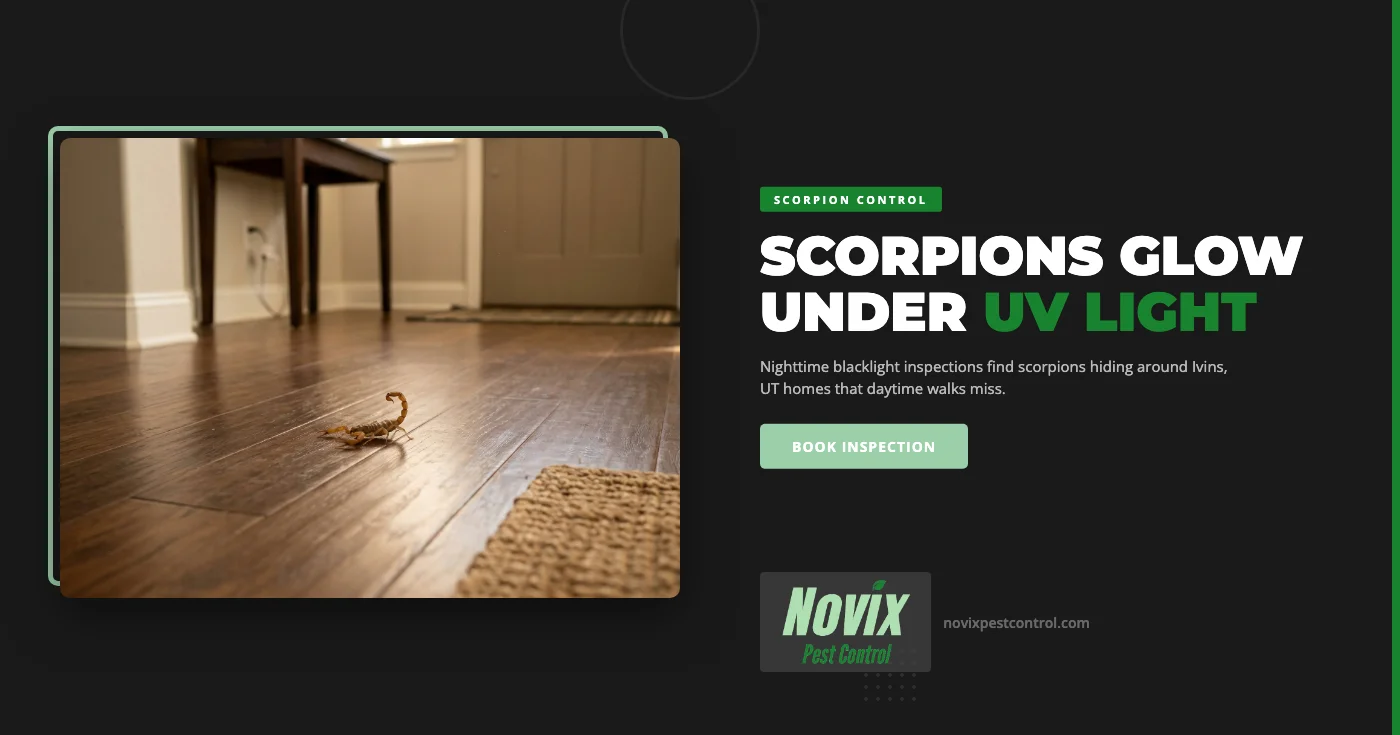
UV Blacklight Scorpion Inspections in Ivins, UT
If you live in Ivins, UT, you already know scorpions are part of the landscape. What most homeowners don't realize is that a daytime walk-through almost never reveals where the problem actually is. Scorpions are masters at tucking themselves into cracks, under rocks, behind wall plates, and inside garages where they sit motionless until well after sunset. By the time you spot one skittering across the kitchen tile, dozens more may already be hiding within ten feet of your foundation.
That's why our team at Novix Pest Control relies on a tool that turns the desert night into something you can actually see — the UV blacklight. Scorpions glow a vivid blue-green under ultraviolet light, and a properly performed nighttime scorpion inspection in Ivins, UT can surface the exact harborage zones that daytime checks miss every time. Below, we'll walk you through how the science works, where Ivins scorpions tend to hide, what to expect during a professional blacklight inspection, and how often local homeowners should schedule one.
Why UV Blacklight Reveals Scorpions Daytime Inspections Miss
Scorpions in southern Utah are almost exclusively nocturnal. During daylight hours, they retreat into rock cracks, masonry voids, irrigation boxes, garage corners, and even attic spaces — places no flashlight beam will easily reach. A daytime visual sweep might catch a few exposed individuals, but it consistently misses the bulk of the population on a property.
UV blacklight inspection works because it flips that script. Once the sun goes down and scorpions emerge to hunt, their exoskeletons fluoresce against the dark landscape. Even a partially exposed scorpion tucked under a flagstone or behind a downspout becomes immediately visible from several feet away. Our technicians can spot a juvenile scorpion the size of a fingernail at distances that would be impossible during daylight, and we can map exactly which sides of the home, which landscape features, and which structural gaps are producing scorpion activity.
For homeowners in Ivins, this distinction matters because our terrain — sandstone outcroppings, red-rock retaining walls, drip-irrigated desert landscaping — creates more hiding spots per square foot than almost any other environment in the country. A nighttime scorpion inspection in Utah's red-rock corridor consistently reveals five to ten times more activity than a comparable daytime walk-through.
The Science Behind Why Scorpions Glow Under Blacklight
Scorpions don't glow because of anything they ate or any trick of reflection. The fluorescence comes from chemical compounds embedded in the hyaline layer of their exoskeleton — specifically beta-carboline and 7-hydroxy-4-methylcoumarin. These molecules absorb ultraviolet light in the 350 to 400 nanometer range and re-emit it as visible blue-green light in the 450 to 500 nanometer range, which is why a scorpion under a 365nm blacklight appears almost neon against the desert floor (see Biology Insights' overview of scorpion fluorescence).
What makes this so useful for pest professionals is that fluorescence is consistent across every life stage and every species found in the region. Adult Arizona bark scorpions, giant desert hairy scorpions, northern scorpions, and even freshly molted juveniles all light up the same way. The only exception is a scorpion that has just shed its exoskeleton — for a few hours after a molt, the new cuticle hasn't fully developed its fluorescent properties. That's a tiny fraction of any inspection.
Researchers still debate why scorpions evolved this trait. Some studies suggest the entire exoskeleton acts like a giant UV sensor that helps the scorpion decide whether it's dark enough to emerge from its hiding spot. Other theories point to mate-finding or natural sun protection. For our purposes as Ivins pest control professionals, the "why" matters less than the "what" — and what we know is that every scorpion on your property will betray its location the moment a 365nm beam hits it.
Common Scorpion Hiding Spots Around Ivins, UT Homes
Ivins homes share a handful of architectural and landscape features that scorpions exploit relentlessly. When our technicians arrive for a nighttime inspection, we already know where to point the blacklight first. The usual harborage zones include:
- Red-rock retaining walls and landscape boulders — the irregular gaps between stacked stones are perfect daytime shelters and prime hunting platforms after dark.
- Drip irrigation boxes and emitter heads — the moisture differential attracts the insects scorpions feed on, which in turn draws scorpions to the same spots night after night.
- Garage door thresholds and weatherstripping gaps — bark scorpions can squeeze through openings as small as the width of a credit card, and Ivins garages are one of the most common entry points.
- Block walls, stucco weep holes, and exterior expansion joints — every wall penetration is a potential harborage.
- Wood piles, palm-tree skirts, and ornamental rock mulch — these provide cool, dark cover within a few feet of the foundation.
- Attic spaces and interior wall voids — the only North American scorpion that climbs vertical surfaces is the Arizona bark scorpion, and it routinely scales stucco walls to reach soffit vents and attic openings.
- Closets, shoes, and bedding — once inside, scorpions seek dark, undisturbed areas where they can wait out the day.
Our experience treating Ivins properties tells us the highest-activity zones are usually within a six-foot ring around the foundation, with secondary clusters around any irrigation infrastructure and any rock feature taller than two feet. A blacklight inspection lets us pinpoint these clusters and target our treatments precisely instead of guessing.
What to Expect During a Nighttime Blacklight Inspection
If you've never scheduled a professional scorpion inspection in Ivins, UT before, here's how our process typically runs. We begin the appointment well after dusk — usually at least an hour after sunset — because scorpions need full darkness before they reliably emerge from their daytime shelters. Inspections during summer months often start between 9:30 and 10:30 PM, when ambient ground temperatures have dropped enough for peak activity.
Our technician arrives with a high-output 365nm UV flashlight, protective eyewear, and detailed property notes from your initial assessment. The inspection itself proceeds in a methodical perimeter sweep:
- Foundation walk — we trace every linear foot of the home's exterior walls, checking weep holes, expansion joints, stucco cracks, and the soil-to-foundation interface.
- Landscape sweep — we examine retaining walls, boulder clusters, planter boxes, irrigation infrastructure, palm-tree skirts, and any wood storage.
- Hardscape inspection — patios, pool decks, walkways, and outdoor kitchen areas all get scanned because their joints and expansion gaps are common scorpion travel corridors.
- Entry-point check — garage thresholds, exterior door sweeps, attic vents, dryer vents, and any utility penetrations are inspected closely.
- Interior sweep when requested — for homes with a confirmed indoor presence, we extend the inspection into garages, basements, laundry rooms, and any other low-light interior space.
Throughout the inspection, we count, photograph, and map every scorpion observation. By the end, you receive a clear picture of where activity is concentrated, which structural gaps need attention, and which landscape modifications will deliver the biggest reduction in scorpion pressure. That data then drives our treatment plan — chemical applications, exclusion work, and habitat modification recommendations are all built on what the blacklight actually revealed.
Frequently Asked Questions About UV Blacklight Scorpion Inspections
Do scorpions really glow under UV blacklight?
Yes. Every scorpion species found in southern Utah fluoresces a bright blue-green under a 365nm UV light, including the Arizona bark scorpion, giant desert hairy scorpion, and northern scorpion. The compounds in their exoskeleton produce the glow consistently across all life stages, with the only brief exception being the few hours immediately after a molt.
How do pest control companies find scorpions in my house in Ivins?
We combine a thorough daytime structural inspection — checking for entry points, harborage zones, and conducive conditions — with a nighttime blacklight sweep that reveals where scorpions actually are. The two phases together produce a far more accurate picture than either one alone.
Is the blacklight harmful to people, pets, or the scorpions themselves?
The UV wavelengths used in scorpion inspection lights are low-intensity and pose no meaningful risk during a brief inspection. We recommend protective eyewear for our technicians because of prolonged exposure, but homeowners and pets present during the inspection are not affected.
Can I do this inspection myself with a blacklight from the hardware store?
You can certainly try, and a hardware-store blacklight will reveal some scorpion activity. What you'll miss is the trained eye that recognizes harborage patterns, identifies the species you're seeing, and knows which structural gaps will keep producing scorpions until they're sealed. Most DIY inspections undercount activity and miss the highest-pressure zones entirely.
How Often Ivins Homeowners Should Schedule Scorpion Inspections
Scorpion pressure in Ivins follows a predictable seasonal pattern, and our recommendation reflects that rhythm. Peak activity runs from late April through early October, when overnight temperatures stay warm enough for scorpions to forage actively. During those months, we recommend a quarterly inspection schedule that includes at least one nighttime blacklight sweep per visit.
Homes with a history of confirmed indoor scorpion sightings — especially Arizona bark scorpion activity — benefit from a more aggressive cadence. In those cases, we typically run monthly blacklight inspections during peak season until interior activity drops to zero for three consecutive months, then transition back to a standard quarterly program.
Newer Ivins construction sites and properties adjacent to undeveloped desert acreage also warrant tighter scheduling. Scorpions displaced by grading and excavation often migrate into the closest occupied structure, so the first twelve months after new-home construction or major landscaping work tend to produce elevated activity. A blacklight inspection during that window lets us catch the migration early and shut down harborage before it becomes a long-term problem.
Winter inspections still have value even though scorpion activity slows. Local ABC4 reporting on scorpion dangers in southern Utah year-round confirms that scorpions don't disappear in cold months — they relocate deeper into walls, attics, and crawl spaces. A winter inspection helps us identify structural vulnerabilities before the next emergence in spring.
Why Novix Pest Control Uses Blacklight for Scorpion Detection in Ivins
We've been treating Ivins, UT properties long enough to know that conventional pest control approaches fall short when it comes to scorpions. A standard perimeter spray without an accurate harborage map leaves the highest-activity zones untouched. Bait stations alone won't address the population either, because scorpions aren't drawn to food bait the way ants or cockroaches are. The only way to reliably reduce scorpion pressure on an Ivins home is to find every concentration point and treat it specifically.
That's exactly what blacklight inspection lets us do. Our licensed technicians map every harborage on the property, target chemical applications to the actual travel corridors, and recommend exclusion work where structural gaps are letting scorpions inside. Combined with habitat modification — removing rock clutter, sealing weep holes, adjusting irrigation timing — this approach consistently delivers meaningful reductions in scorpion activity over a single season.
It's also the approach that university research supports. The Utah State University Extension scorpion resource specifically recommends nighttime inspections with a blacklight when scorpions are suspected in or around a structure. We've built our entire Scorpion Control program in Ivins around that recommendation because it works.
If you've spotted a scorpion inside your Ivins home, noticed activity around the foundation at night, or just want to understand what's happening on your property after dark, a professional UV blacklight inspection is the most effective starting point. We'd rather find every hiding scorpion now than have you find one the hard way later — and we have the equipment, training, and local experience to make that happen.