
Bed Bug Prevention for Leeds, UT Travelers
Bed Bug Prevention for Leeds, UT Travelers
Summer travel season in southwestern Utah runs from late May through Labor Day, and Leeds homes sit right in the middle of it. With Zion National Park 30 minutes east and the I-15 corridor carrying steady traffic between Las Vegas and Salt Lake City, Leeds residents log a lot of nights in hotels and vacation rentals between June and August. By the time families return for the school year, our crews are fielding a noticeable uptick in bed bug calls across Washington County.
At Novix Pest Control, we treat bed bug cases year-round, but the surge that follows summer travel is the most predictable pattern we see. This guide to bed bug prevention in Leeds, UT walks through why summer travel drives the spike, how bed bugs hitchhike home, the room check we recommend at every hotel, the steps every traveler should take on returning, the earliest warning signs at home, and when to bring in our bed bug exterminator service in Leeds, UT.
Why Summer Travel Drives Bed Bug Cases Across Southern Utah
Three things converge during a southern Utah summer to push bed bug activity into Leeds homes. None of them are new — they just stack on top of each other between June and August.
- Travel volume peaks. Zion alone moves over five million visitors a year, most of that traffic concentrated between Memorial Day and Labor Day. Hotels in St. George, Hurricane, and La Verkin run near full occupancy, and higher turnover means more chances for bed bugs to move between rooms on luggage.
- Reproduction rates climb with temperature. Bed bugs develop fastest in the 70 to 90°F range — egg to adult in about a month. The Environmental Protection Agency notes that warmer conditions shorten the life cycle dramatically. A small introduction in May can become a serious problem by August.
- Short-term rentals add a second vector. Vrbo, Airbnb, and traditional vacation rentals have grown across Washington County, and many turn over weekly through summer. A single guest carrying bed bugs can leave a property primed for the next family to bring them home.
The net effect is that bed bug pressure on Leeds homes is not driven by local conditions — it is imported, one suitcase at a time, between June and September.
How Bed Bugs Hitchhike Home from Hotels and Rentals
Bed bugs do not fly, jump, or move quickly across open ground. Every introduction into a Leeds home traces back to physical contact between an infested surface and something you carried with you. Understanding how that contact happens is the first step in stopping it.
- Luggage on the bed or floor. The single most common vector. A suitcase resting on a hotel mattress for a few hours is enough for a hitchhiking adult or egg cluster to settle into the lining seams.
- Folded clothing returned to drawers. Bed bugs hide in dresser drawer joints. Clothes folded into those drawers and packed home are a reliable transfer route.
- Books, electronics, and soft items. Anything with seams, folds, or recesses — laptop sleeves, stuffed animals, paperback books left on the nightstand.
- Backpacks set on luggage racks. Hotel luggage racks themselves can harbor bed bugs in the strap webbing.
Pre-Check: Inspecting Your Room Before You Unpack
The five-minute room check we recommend at every hotel and rental in southern Utah catches the overwhelming majority of bed bug problems before luggage ever touches the bed. Walk this every time, regardless of the property's star rating.
- Park luggage in the bathroom first. Tile floors, bright light, and no soft surfaces — bed bugs cannot hide there. Suitcases stay in the tub or on the tile until the room is cleared.
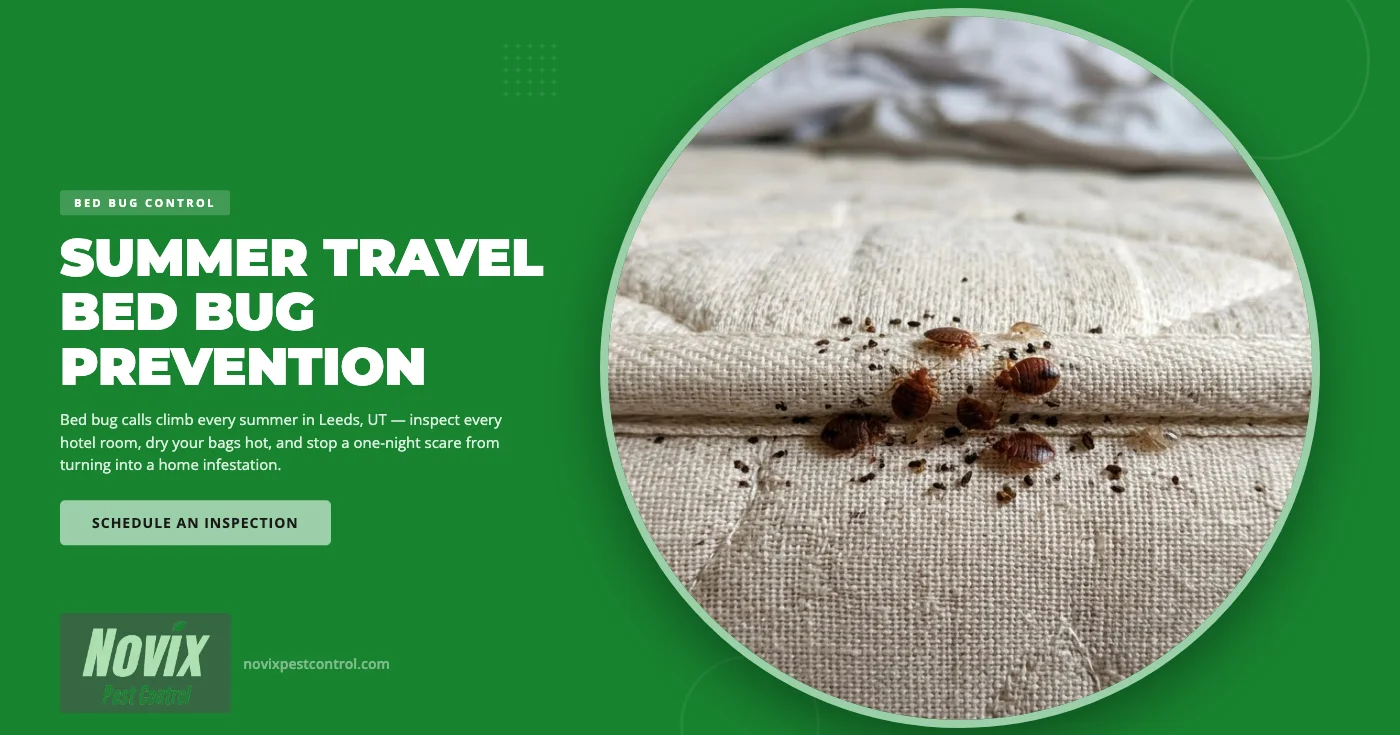
- Pull back the sheets and inspect the mattress seams. Use a phone flashlight. Look at all four corners of the mattress, especially the piped seam where the top fabric meets the side panel. Adult bed bugs are the size of an apple seed, reddish-brown, and flat when unfed. Live bugs, shed skins, or dark fecal dots on the seam are all positive signs.
- Check the box spring and headboard. Lift the mattress at the corner and look at the box spring's piped edge. Then move to the headboard — most hotel headboards are wall-mounted and rarely cleaned behind. Use a credit card to slide behind it where you can.
- Scan the surrounding fabric. Look at the upper edges of curtains, the seams of upholstered chairs and headboards, and the back side of any decorative pillows.
- Check behind picture frames and along baseboards. Heavy infestations spread to wall-mounted frames and the upper edge of the baseboard near the bed.
If you find a live bug, shed skins, or dark fecal staining: do not unpack. Take photos, return to the front desk, request a different room in a different part of the property (bed bugs spread to adjacent rooms), and inspect the new room the same way before settling in.
Post-Trip: Steps to Take When You Return to Leeds
Even with a clean pre-check at every property, the smartest assumption is that something hitchhiked home. The handful of steps we walk Leeds homeowners through on their return trip cuts the risk of a household introduction to nearly zero.
- Unload luggage in the garage, not the bedroom. Pull every bag out of the car directly into the garage. Do not carry suitcases through the house to the bedroom.
- Run everything through the dryer on high heat. The Centers for Disease Control and Prevention confirms that bed bugs and their eggs are killed by sustained exposure to temperatures above 120°F. Thirty minutes on the highest dryer setting handles every life stage. This includes items that were never worn — anything that was in the suitcase.
- Vacuum the luggage interior thoroughly. Hit every seam, lining, and pocket. Empty the vacuum canister into a sealed bag and put it directly in the outdoor trash. If your vacuum uses bags, replace the bag and dispose of it the same way.
- Store luggage outside the bedroom. A sealed plastic tote in the garage works well, or hang soft-sided bags from a hook where they cannot rest against soft surfaces. Bedroom closets are the single worst storage location.
- Inspect electronics and books separately. Wipe down hard surfaces and shake out anything with pages or folds. Soft kids' items go through the dryer.
None of these steps require special equipment. The dryer alone handles the heavy lifting — what matters is doing it before luggage gets carried to the bedroom.
Early Warning Signs of a Bed Bug Infestation at Home
If a hitchhiker made it through the pre-check and the post-trip routine, the first signs typically show up two to six weeks after the trip. The earlier you catch it, the easier the treatment.
- Bite patterns on arms, legs, neck, or shoulders. Bed bug bites typically appear in linear runs of three or in tight clusters. They show up overnight on skin that contacted the mattress, and many people do not react for several days.
- Dark fecal spotting on sheets, pillowcases, or the mattress edge. These look like fine black dots about the size of a marker tip, often along the piped seam of the mattress or where the mattress meets the headboard.
- Small blood smears on sheets. Crushed bed bugs leave reddish-brown smears, usually near where someone has been sleeping.
- Pale shed skins in mattress seams. The hollow translucent shells from molting nymphs collect in seams and folds.
- Live bugs along seams, in headboard cracks, or at the carpet edge near the bed. Adults are reddish-brown and roughly apple-seed sized. Nymphs are smaller and more translucent.
- A faint sweet, musty odor in heavy infestations. By the time the smell is noticeable, the population is well established.
Bed bug bites are commonly misattributed to mosquitos or heat rash during southern Utah summers. If bites appear only overnight, in a consistent location, and in runs or clusters, treat bed bugs as the working theory and inspect the bed accordingly.
When to Call Novix for Professional Bed Bug Treatment
DIY bed bug treatments rarely finish the job. Bed bugs hide in cracks as thin as a credit card, eggs are not affected by most over-the-counter sprays, and a missed pocket of ten eggs becomes a full infestation again in six weeks. Our bed bug exterminator service in Leeds, UT is built around three connected phases:
- Inspection and harborage mapping. We start in the primary bedroom and expand outward — second bedrooms, sofas, recliners, and any spots where adults regularly rest. Bed bugs harbor wherever a person sits or sleeps for hours.
- Multi-modal treatment. Depending on the severity and the structure, we combine residual chemical application in cracks and crevices, targeted heat where appropriate, mattress and box spring encasements, and follow-up vacuuming. Adults, nymphs, and eggs each respond differently — a single approach misses one of them.
- Two-visit minimum with verification. A second visit two to three weeks later catches eggs that hatched after the first treatment. We do not call a job complete until the follow-up inspection comes back clear.
We are licensed and insured, and our team holds a 4.8-star reputation across Leeds, St. George, Washington, and the rest of Washington County. If bites are appearing, you have spotted warning signs, or you returned from a trip with luggage that may have been in an infested room, the right move is a professional inspection before the population establishes.
Frequently Asked Questions About Bed Bug Prevention in Leeds, UT
How do bed bugs get into Leeds, UT homes in the first place?
Nearly every introduction in southern Utah traces back to travel — hotels, short-term rentals, and stays in other family members' homes. Bed bugs do not establish outdoors and do not move between homes through walls in single-family construction. The luggage, clothing, or soft item carried home from a trip is almost always the vector. Used furniture and secondhand mattresses are a distant second.
What should I look for when checking a hotel room for bed bugs?
Pull the sheets back and inspect the piped seam of the mattress at all four corners under a flashlight. Look for live reddish-brown bugs about the size of an apple seed, pale shed skins, dark fecal spotting, or small blood smears. Then check the box spring's piped edge, behind the headboard, the upper edge of the curtains, and the seams of any upholstered chairs. Five minutes covers the room thoroughly.
Do bed bug bombs or foggers actually work?
No, and they often make the problem worse. Foggers push bed bugs deeper into wall voids and adjacent rooms rather than killing them, and they have no effect on the eggs. Professional residual treatment placed in the cracks where bed bugs actually harbor is far more effective.
How long can bed bugs survive without feeding?
Adult bed bugs typically survive two to three months without a blood meal at normal indoor temperatures, and some can stretch longer in cooler conditions. This is why a hitchhiker that rode home in summer luggage can sit dormant in a closet and only show up when the bag is opened months later.
Get Ahead of Bed Bug Season Before You Travel
Most of the bed bug calls we field in Leeds between July and September trace back to a single trip earlier in the summer where no one ran the five-minute room check. The prevention work is simple — luggage in the bathroom, seams checked under a flashlight, dryer on high when you return — and it spares Leeds homeowners the cost and stress of a full residential treatment.
If you have spotted bite patterns, fecal staining, or live bugs along a seam, our team can build a treatment plan for your Leeds home. Learn more about our bed bug exterminator service in Leeds, UT and reach out to schedule a visit — we serve Leeds, St. George, Washington, Hurricane, La Verkin, Ivins, Santa Clara, and the surrounding southern Utah communities.