
Spider Control in Santa Clara, UT
Spider Control in Santa Clara, UT
Spider activity inside Santa Clara, UT homes climbs sharply once daytime highs settle into the 90s and overnight lows stay warm — a window that opens in late May and runs through September. By early June, our crews start fielding calls about webs reappearing in the same eaves, window wells, and garage corners as last summer.
At Novix Pest Control, we treat hundreds of southwestern Utah properties for spiders each season, and the difference between a one-visit knockdown and a recurring summer problem usually comes down to timing and exterior conditions. This guide to spider control in Santa Clara, UT covers why summer brings spiders indoors, the species you are likely to see, early signs of pressure on your property, the yard and sealing steps that actually move the needle, and how our team handles spider season for desert homes.
Why Santa Clara Spiders Move Indoors During Peak Summer Heat
Santa Clara sits in one of the warmest, driest pockets of Utah. June averages 65 to 90°F, July climbs to a 94°F daily high, and July humidity hovers around 27 percent. Those conditions are punishing for ground-dwelling arthropods, and spiders respond by migrating to micro-climates that buffer the extremes.
Three things happen at once during a Santa Clara summer:
- Heat refuge: Surface temperatures on red-rock landscaping and stucco can exceed 130°F in direct sun. Spiders shelter in shaded cracks, weep holes, garage corners, and window wells, where temperatures sit 20 to 30 degrees lower.
- Water seeking: With humidity in the 20s, moisture matters. Spiders gravitate toward irrigation drip lines, AC condensate, pet bowls, leaky hose bibs, and the cool condensation around basement windows.
- Prey following: Heat drives crickets, earwigs, moths, mosquitoes, and ants toward the same shaded perimeter. Spiders are predators — they go where the prey concentrates.
The result is a steady migration from open desert into the perimeter and interior of homes. Most Santa Clara homeowners notice it first as webs reappearing in exterior corners by mid-June, then as occasional indoor sightings in basements, garages, and laundry rooms through July and August.
Common Spider Species You'll Encounter in Southwestern Utah Homes
Most of the spiders we identify on Santa Clara calls fall into five groups. Knowing which one you are looking at changes how urgent the treatment is.
- Western black widow (Latrodectus hesperus): The one species worth real concern in southern Utah. Glossy black with a red or orange hourglass on the underside of the abdomen, building irregular tangled webs low to the ground in dark, undisturbed spots. Window wells, garage door L-corners, beneath stored items, and outdoor electrical boxes are the classic Santa Clara locations.
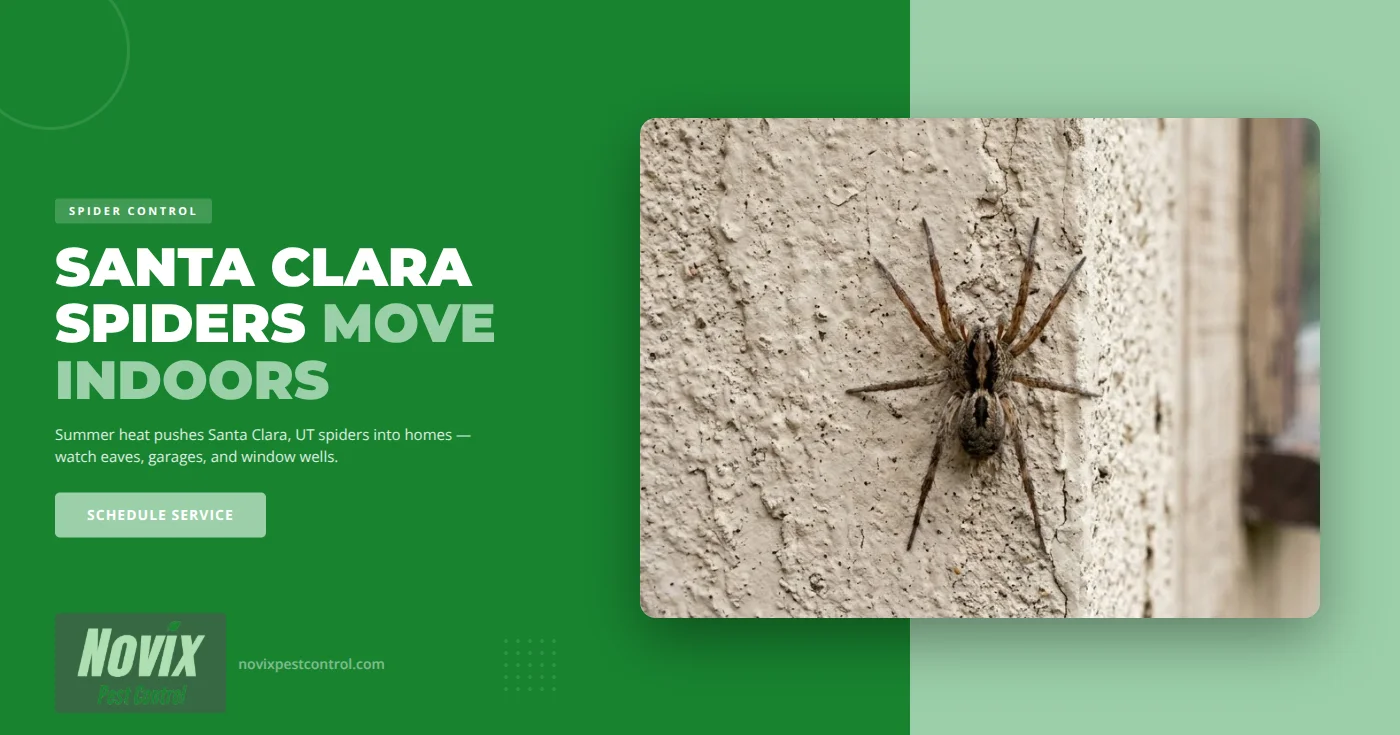
- Wolf spiders (Hogna and related genera): Large, fast brown or gray hunters that do not build webs. They chase prey on the ground and occasionally wander indoors through open garage doors at dusk. Imposing, but not medically significant.
- Crevice weavers (Filistatidae): Large brown six-eyed spiders that build messy radial webs around exterior cracks, weep holes, and stucco seams. Utah State University Extension notes these are the species most often submitted from southern Utah counties — and they are frequently mistaken for brown recluse. Brown recluse do not occur in Utah.
- Camel spiders (Solifugae): Not true spiders, but common here. Fast nocturnal hunters with prominent jaws. They have no venom glands; bites sting but pose no real medical risk.
- Orb weavers (banded and similar): The classic round-web builders that appear overnight on patios. Visually striking, harmless to humans, and gone on their own by late fall.
A glossy black spider on a tangled low web — especially in a window well or behind storage — should be treated as a black widow until confirmed otherwise. Keep children and pets clear of the area.
Signs Your Santa Clara Property Is Attracting Spiders
A 10-minute walk around your property in early summer will surface most of the warning signs. Look for:
- Webs returning to the same exterior corners: Eaves, soffit joints, the upper corners of window frames, and the gap between garage door tracks and the trim.
- Heavy insect activity at exterior lighting: Porch sconces, garage coach lights, and landscape uplights pull moths and beetles. Where those insects cluster, spider webs follow within a week or two.
- Egg sacs in low-traffic storage: Pea-sized white or tan silk sacs in garage shelving, window wells, RV bays, and under patio furniture mean an established adult is producing the next generation on-site.
- Tangled cobwebs in window wells: The single most common black widow micro-habitat across Washington County. Window wells full of leaves, drip residue, and old webbing are ideal for them.
- Cricket and earwig numbers climbing: Spiders track prey. A surge of crickets on the front porch in May is a reliable forecast for spider pressure in July.
Yard and Landscape Steps That Reduce Spider Pressure
Most of the spider pressure on a Santa Clara home is driven by what is happening in the 10 feet immediately outside the foundation. A handful of landscape adjustments cut indoor sightings dramatically:
- Move firewood, rock piles, and lumber off the foundation. Stacked material against the house creates ideal cool, humid harborage. Pull it back at least three feet and elevate it on a rack.
- Trim shrubs and tree limbs away from the structure. Anything touching the stucco gives spiders a direct bridge to eaves and second-story windows. Aim for a 12-inch clearance.
- Adjust drip irrigation and hose bibs. Damp foundation soil pulls every moisture-seeking insect — and the spiders that hunt them. Check for leaks at hose bibs and irrigation manifolds.
- Swap exterior bulbs to yellow or sodium-vapor. Standard white LEDs attract swarms of insects after dark. Warm yellow bulbs draw far fewer prey insects to porch and garage entry points.
- Clean out window wells. Pull leaves, sticks, and old webbing twice a year. A clean, dry window well is far less attractive to black widows than a debris-filled one.
- Manage the landscape mulch line. Deep organic mulch against the foundation holds moisture and harbors crickets. A 6-inch gravel band against the foundation works far better in our climate.
Sealing Entry Points: Where Spiders Sneak Into Desert Homes
Once exterior pressure is high, the next question is how spiders are crossing into the conditioned space. The repeat offenders we find on Santa Clara homes:
- Worn door sweeps: Front, back, and garage walk-through doors lose their bottom seal after a few summers of UV. A 1/8-inch gap is plenty for a wolf spider.
- Damaged window screens: Tears at corners, screens pulled out of the frame channel, and missing screens on rarely opened basement windows.
- Stucco cracks and weep holes: Hairline cracks at corners and around penetrations are spider highways. Weep holes have to drain but can be screened.
- Utility penetrations: Where the AC line set, gas line, electrical, cable, and irrigation enter the wall, the rubber boot or foam seal often shrinks. A bead of exterior caulk closes it.
- Garage door side seals: The vertical rubber strip along the garage door jamb tears easily. Spiders, scorpions, and crickets all use the resulting gap.
- Attic and crawlspace vents: Missing or torn screen behind a louvered vent gives a direct route into the upper structure.
None of these fixes are exotic — the challenge is finding all of them on a single walk, which our team does on every exterior visit.
When to Call a Professional Spider Exterminator in Santa Clara
Plenty of single sightings are nothing to act on. The triggers that warrant a professional visit:
- Confirmed black widow on the property, especially in window wells, garage corners, around play equipment, or near pet areas.
- Webs returning within a week of being knocked down — a sign of an established population, not a passing visitor.
- Multiple egg sacs in storage areas, meaning the next generation is already in production indoors.
- Crickets, earwigs, or other prey climbing in volume, which forecasts a spider surge two to four weeks out.
- Family members nervous about kids or pets in the yard during peak black widow activity in July and August.
When any of those apply, the right move is a professional exterior treatment timed before populations peak — typically late May through mid-June for the cleanest results.
How Novix Pest Control Handles Summer Spider Season
Our spider workflow for Santa Clara homes is built around three ideas: cut off the prey supply, treat the exterior perimeter, and clear visible webs so new activity stands out immediately. A typical visit runs:
- Property walk and species ID: We confirm what we are treating, flag any black widow harborage, and note high-pressure micro-habitats — window wells, garage corners, weep holes, irrigation manifolds.
- Exterior perimeter treatment: A residual on the foundation, eaves, window and door frames, and a three-foot perimeter band that handles both prey insects and the spiders tracking them.
- Targeted spot treatment: Direct application into window wells, garage corners, weep-hole runs, and any harborage flagged on the walk.
- De-webbing: Physical removal of existing webs and egg sacs so the property resets visually and return activity is obvious next visit.
- Recommendations: If a particular eave, light fixture, or storage spot keeps producing webs year over year, we flag the structural or landscape fix that breaks the cycle.
- Quarterly program option: Homes on our recurring program rarely see indoor spiders — the same residual that handles ants, crickets, and scorpions suppresses spider pressure all season.
We are licensed and insured, and spider work runs as part of our broader residential program. Our team holds a 4.8-star reputation across Santa Clara, Ivins, St. George, Washington, and the rest of Washington County.
Frequently Asked Questions About Spider Control in Santa Clara, UT
Are there brown recluse spiders in Santa Clara, UT?
No. Brown recluse do not occur in Utah, despite what online identification apps frequently suggest. The species most often mistaken for brown recluse in our area is the crevice weaver — a large brown, six-eyed spider with messy webs around exterior cracks. Crevice weavers are not medically significant. The species worth real attention in Santa Clara is the western black widow.
How do I tell a black widow from other dark spiders in my window well?
Look for three features together: glossy jet-black body, a rounded bulbous abdomen, and a red or orange-yellow hourglass on the underside of that abdomen. Black widow webs are irregular and tangled rather than orderly, and the spider typically hangs upside down inside the web. If you suspect a black widow, do not try to capture it — note the location and call a professional.
Do indoor sprays from the store actually keep spiders out?
Indoor aerosol sprays handle the spider you can see, but they do not address the exterior pressure feeding the problem. Spiders enter because prey insects are concentrated around the foundation and entry points are open. A perimeter exterior treatment plus sealing delivers far better results than repeated indoor spraying.
How long does a professional spider treatment last in southern Utah?
An exterior residual application typically suppresses spider activity for six to eight weeks under summer conditions. Properties on a quarterly recurring program rarely see indoor spiders at all, because the residual is refreshed before it degrades and de-webbing keeps populations from re-establishing.
Get Ahead of Summer Spider Season in Santa Clara, UT
Early summer is the cleanest window of the year to handle spiders in Santa Clara. Populations are still building, black widows have not hit peak activity, and a single exterior visit carries coverage deep into August. The longer the visit waits, the more established the colonies — and the more visible the indoor activity by the time the call goes in.
If webs are reappearing in the same corners, crickets are climbing at your porch, or you have confirmed a black widow in a window well, our team can build a plan for your property. Learn more about our spider exterminator service in Santa Clara, UT and reach out to schedule a visit — we serve Santa Clara, Ivins, St. George, Washington, and the surrounding desert communities.