
Why Subterranean Termites Stay Active Into Fall in Santa Clara, UT Homes
Why Subterranean Termites Stay Active Into Fall in Santa Clara, UT Homes
By mid-September in Santa Clara, UT, overnight lows are slipping into the mid 60s and daytime highs dropping into the mid 90s. To a homeowner, that shift feels like the end of pest season. To a subterranean termite colony working the soil beneath a Santa Clara property, it means very little — the top two feet of desert soil where these termites forage stays well within their preferred range for another two months. Fall doesn't send subterranean termites away. It changes how deep they work, when they swarm, and where a homeowner is most likely to see the damage they've been quietly producing all summer.
If you're seeing sand-textured mud lines running up your foundation, hearing a hollow sound when you tap baseboards, or noticing discarded wings on window sills after a monsoon storm, you're seeing the classic fall pattern every southern Utah pest professional watches for. This guide covers what subterranean termites are doing in Santa Clara, UT right now and how our team at Novix Pest Control handles termite control in Santa Clara, UT.
How Subterranean Termites Behave in the Desert Southwest
Subterranean termites are the most common termite in Utah. Per Utah State University Extension, they nest underground — sometimes more than 15 feet below the surface — and send workers out through soil tunnels to locate wood in contact with the ground. Two related species drive most termite control calls we handle in Santa Clara, UT: the western subterranean termite (Reticulitermes hesperus) and the arid-land subterranean termite (Reticulitermes tibialis), well-adapted to the climate around St. George, Ivins, and Santa Clara.
A mature colony contains between 60,000 and several hundred thousand individuals across three castes: workers (cream-colored, wingless termites that consume wood), soldiers (dark mandibles that defend the colony), and reproductives (winged alates that leave each spring and fall to establish new colonies). A single colony can drop foraging tunnels across a quarter-acre area — which is why one Santa Clara property may show multiple entry points into a single structure.
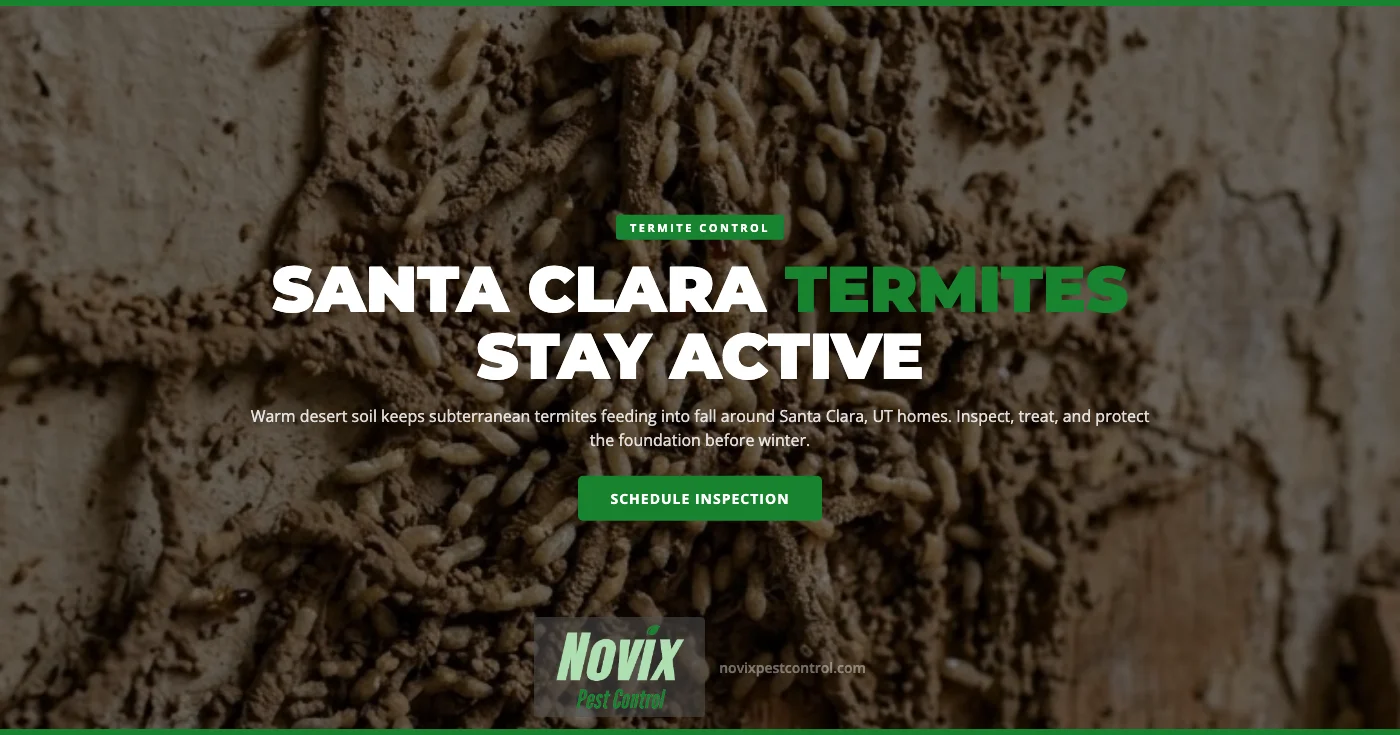
Because subterranean termites dry out quickly when exposed to open air, they build mud tubes — pencil-thin earthen pathways of soil, saliva, and fecal material — to bridge the gap between the soil and wood above ground. Mud tubes running up a stem wall or through a crawl space beam are the most diagnostic sign of subterranean termites in Utah homes. The UC IPM Pest Notes on Subterranean and Other Termites emphasize that colonies concentrate anywhere consistent moisture, wood contact, and moderate temperature converge — conditions most Santa Clara properties provide year-round through landscape irrigation.
Why Santa Clara, UT Soil Temperatures Keep Termites Active Into Fall
Subterranean termite activity is governed by soil temperature more than by air temperature. That distinction is what makes fall termite pressure so persistent in Santa Clara, UT.
Peer-reviewed studies on Reticulitermes hesperus put optimal worker activity between roughly 57°F and 66°F. In Santa Clara, UT, the top two feet of soil sits well inside that band from early April through late November. Ground temperatures at the depth where workers feed lag surface air temperatures by four to six weeks, so by the time a homeowner is pulling out a sweatshirt at night, the termite workers beneath the driveway are still hunting at their most productive rate of the year.
Three additional drivers keep pressure elevated through September, October, and often into November across Santa Clara, UT and the greater St. George area:
Monsoon-driven moisture holds through fall. July and August storms dump enough water into desert soils that mulch beds and drainage swales carry residual moisture past the last storm cell. Subterranean termites travel farther and tunnel more aggressively when soil moisture is elevated.
Fall alate swarms. Reproductive termites leave established colonies in two annual pulses: a large spring emergence and a smaller fall emergence, typically on warm afternoons following a soaking rain. A fall swarm on your patio, driveway, or window sill is one of the clearest signs that a mature colony is already established within about 150 feet of your home.
Pre-winter feeding intensifies. Colonies stockpile cellulose reserves before winter to support the queen's laying rate through the dormant period. Worker foraging typically peaks between mid-September and early November — precisely when a fall termite inspection is most likely to catch active tunneling before the colony slows.
Warning Signs of Subterranean Termite Damage Around Your Home
Subterranean termites work slowly, quietly, and almost entirely out of sight. The problem for the average Santa Clara, UT homeowner isn't identifying an obvious infestation — it's noticing the subtle early indicators before structural damage sets in. Our technicians look for the following during every termite inspection in Santa Clara, UT:
- Mud tubes. Pencil-diameter earthen tubes running up stem walls, along garage slab edges, across crawl space piers, or through weep holes are the most diagnostic sign of an active subterranean colony. Even abandoned-looking tubes should be broken open and monitored — workers routinely rebuild through the same pathway once treatment ceases.
- Discarded wings. After a fall alate flight, reproductives shed their four equal-length wings in a small pile at window sills, door thresholds, or the corner of a garage. A pile of shed wings inside the home indicates a colony has produced reproductives in or adjacent to the structure.
- Hollow-sounding or blistered wood. Because subterranean termites consume the interior of a wood member and leave paint or veneer intact, damaged wood often looks fine from the outside. Tapping baseboards, door frames, and window casings with a screwdriver handle produces a distinctive hollow tone where workers have been feeding.
- Buckled paint or bubbled drywall. Termite workers introduce moisture into the wood they consume. That moisture eventually shows up as paint blisters, warped baseboards, or a faint bulge in drywall along a stud line — particularly on exterior-facing walls and shared walls with irrigated landscape beds.
- Sticking doors and windows. Termite damage combined with introduced moisture can swell wood framing enough that doors and windows begin sticking. Any door or window that started sticking through late summer and hasn't loosened up as humidity dropped deserves an inspection.
A single sign is not a diagnosis. Two or more of these signs on a Santa Clara property in September or October is the strongest case for scheduling a professional termite inspection before winter.
How Irrigation and Landscaping Create Termite Pathways to Your Foundation
The biggest driver of subterranean termite pressure on any Santa Clara, UT property isn't the desert climate — it's the moisture and wood contact created by landscape irrigation. Every irrigated zone within 10 feet of the foundation, every wood-in-soil contact point, and every drainage failure creates a pathway subterranean termites reliably follow.
Irrigation against the foundation. Drip emitters positioned within 18 inches of the stem wall keep soil directly against the foundation at optimal termite moisture year-round. Move emitters and rotor heads away from the foundation and slope the soil so runoff drains outward.
Mulch beds against the house. Organic mulch piled against a foundation wall creates a moist, insulated soil interface under any point of possible wood contact. Keep a clear zone of 12 to 18 inches between organic mulch and the foundation, and use decorative rock in the strip closest to the house.
Wood-in-soil contact. Wood siding, trim, posts, and stucco extensions that reach the soil line become direct termite pathways. Per USU Extension guidance, wood siding, stucco, and foam board should terminate at least six inches above finished grade. Fence posts and decorative timbers set into soil should be pressure-treated to a ground-contact rating.
Firewood and cellulose debris. Stacked firewood against a garage wall, leftover framing lumber under a patio cover, and buried construction scrap are among the most productive termite starter colonies we recover on Santa Clara properties. Move firewood at least 20 feet from the structure and elevate it off the soil.
Drainage failures. Gutters that empty against the foundation, downspouts that discharge into landscape beds, and grading that slopes toward the house keep foundation-adjacent soil moist for weeks after rainfall. Extend downspouts at least six feet from the house and regrade any zone where water pools near the stem wall.
When Fall Is the Best Time for a Termite Inspection
Fall — specifically the September-through-mid-November window — is the highest-value termite inspection period on the southern Utah pest calendar. Three reasons hold on every Santa Clara property we service:
Colonies are at peak forage before winter. Because subterranean colonies stockpile cellulose going into winter, worker traffic is at its annual maximum through September and October. Active mud tubes are more visible, worker termites are easier to recover, and the pattern of foraging tells our technicians where the colony is likely concentrated.
Fall swarms provide diagnostic evidence. The fall alate flight — usually a warm afternoon after a soaking September rain — leaves discarded wings and colony landmarks a spring inspection couldn't detect. Wing piles on a window sill during a September termite inspection in Santa Clara, UT can pinpoint the colony's approximate location to within one exterior wall.
Winter is the right treatment window. Termite treatment in the St. George area applied in late fall and early winter puts the active ingredient in contact with the colony while workers are still moving through treated soil zones. A fall inspection followed by a winter treatment cycle is the strongest combination for termite prevention in southern Utah, positioning the property ahead of the spring alate flight rather than reacting to it.
Homeowners planning a real estate transaction, a remodel, or a re-roof particularly benefit from a fall termite inspection. A colony that's tolerated for years can move aggressively when the soil is opened up, regraded, or newly irrigated.
Professional Termite Treatment Options for Santa Clara Homeowners
At Novix Pest Control, our approach to termite control in Santa Clara, UT runs as an inspection-first program. We don't apply blanket termiticide to a property that hasn't been mapped. Every project starts with a full property walk and works outward from evidence to a plan tailored to the specific colony, structure, and landscape.
Full inspection. Our licensed technicians walk the full property — interior baseboards, garage, crawl spaces, attic access points, exterior stem wall, and every wood-in-soil contact point. We probe suspect wood with sounding tools, break and monitor active mud tubes, and document findings with photos and location notes.
Liquid termiticide barriers. The most reliable approach on most Santa Clara properties is a non-repellent liquid termiticide applied as a soil barrier around the foundation. Non-repellent chemistry (fipronil, chlorantraniliprole, imidacloprid) is designed so foraging workers cannot detect the treated zone, walk through it during normal foraging, and carry the active ingredient back into the colony through trophallaxis. Applied correctly, a non-repellent barrier can eliminate an entire colony within 60 to 90 days.
In-ground bait stations. For properties where landscape design, drainage, or slab configuration make a full trench-and-treat impractical, in-ground bait stations placed around the foundation provide a monitored, low-disturbance alternative. Stations use a cellulose matrix with a chitin synthesis inhibitor that workers feed on and carry back to the colony.
Structural corrections. Effective termite prevention in southern Utah pairs termite treatment with structural and landscape corrections: relocating drip irrigation, correcting drainage against the foundation, replacing wood-in-soil contact points with steel or masonry, and sealing foundation cracks. Our team works these corrections into every treatment plan and follows up during our ongoing residential pest control program.
Ongoing protection keeps a quarterly perimeter check running so any resurgence — a new mud tube, a shift in colony activity, or a landscape change that opens a new pathway — is caught before structural damage sets in. Our team serves Santa Clara, St. George, Ivins, Washington, and Leeds with a 4.8-star reputation across southern Utah. If you're seeing mud tubes, discarded wings, or the subtle indicators of an active subterranean termite colony in Santa Clara, UT this fall, reach out and our team will schedule a full inspection and build a plan tailored to your property.