
Fall Spider Activity in Washington, UT: Why October Brings More Spiders Indoors
Fall Spider Activity in Washington, UT: Why October Brings More Spiders Indoors
By the first full week of October in Washington, UT, overnight temperatures drop into the mid-50s while daytime highs still cross into the low 80s. For the spider population already living in and around your home, that pressure band is the annual cue to breed, lay eggs, and — in the case of mature males — leave the web and wander. If you have noticed webs returning to the same eave corners, a new egg sac in a window well, or an unfamiliar spider crossing a hallway at 11 p.m., you are seeing the pattern our technicians work every October across the greater St. George area.
October spider activity in Washington, UT concentrates for three reasons at once: peak western black widow egg-sac season, the peak of male-spider wandering season across most other species, and the seasonal shift of prey insects toward occupied structures. This guide covers how those shifts hit Washington homes, which species we see on fall service routes, how to identify a western black widow before you reach into a window well, and how our team at Novix Pest Control handles spider control in Washington, UT.
Why October Brings More Spider Activity Into Washington, UT Homes
Two separate biological cycles converge on Washington, UT in October, and together they produce the sharp spike in spider sightings our team logs across the first three weeks of the month.
The first is spider mating season. Per Utah State University Extension, fall is when spider encounters are most likely in Utah — a season driven by spiders maturing, searching for mates, and laying eggs. Across most of our common species, mature males abandon their webs in late August and spend the next six to eight weeks wandering in search of females. By early October, that wandering is at its peak. The familiar "I suddenly have more spiders in my house" jump is not a new infestation; it is the same spider population finally becoming visible as the males leave their hidden harborage.
The second cycle belongs to the western black widow (Latrodectus hesperus), the medically significant species that drives most of our serious spider calls in Washington County. Females that mated in late summer are now in peak egg-sac season — a single female can produce multiple sacs between September and November, each holding roughly 200 to 400 eggs. The sacs hang in three-dimensional cobwebs in dark harborage, which in a Washington, UT home means window wells, garage corners, utility meter boxes, and the back side of exterior storage.
Pressing on both cycles is a third shift: as monsoon moisture draws down through September and outdoor prey insects start dying off, the survivors concentrate wherever moisture and warmth remain — primarily around residential structures. More prey around the foundation means spiders stay close to the house and reproduce in those corners.
The common belief that cold weather pushes spiders indoors is largely a myth. Most of the spiders you see in October have been living in or alongside your home all year — they simply become visible as males wander and females reach peak reproduction.
Common Spider Species Found in Washington, UT Properties
Washington, UT sits at roughly 2,700 feet in the Mojave Desert transition zone, and the spider community reflects that climate. On a typical fall service route, our licensed technicians identify the following species most often:
- Western black widow (Latrodectus hesperus). The spider that drives nearly every medically meaningful call we run in Washington County. Covered in detail in the next section.
- Desert crevice weaver (Kukulcania arizonica). A common southern Utah submission to the Utah Plant Pest Diagnostic Lab. Dark brown, roughly an inch across, with a dense wool-like web built into rock cracks, block-wall weep holes, and stucco-to-foundation gaps. Not medically significant to most adults, but often misidentified as a recluse.
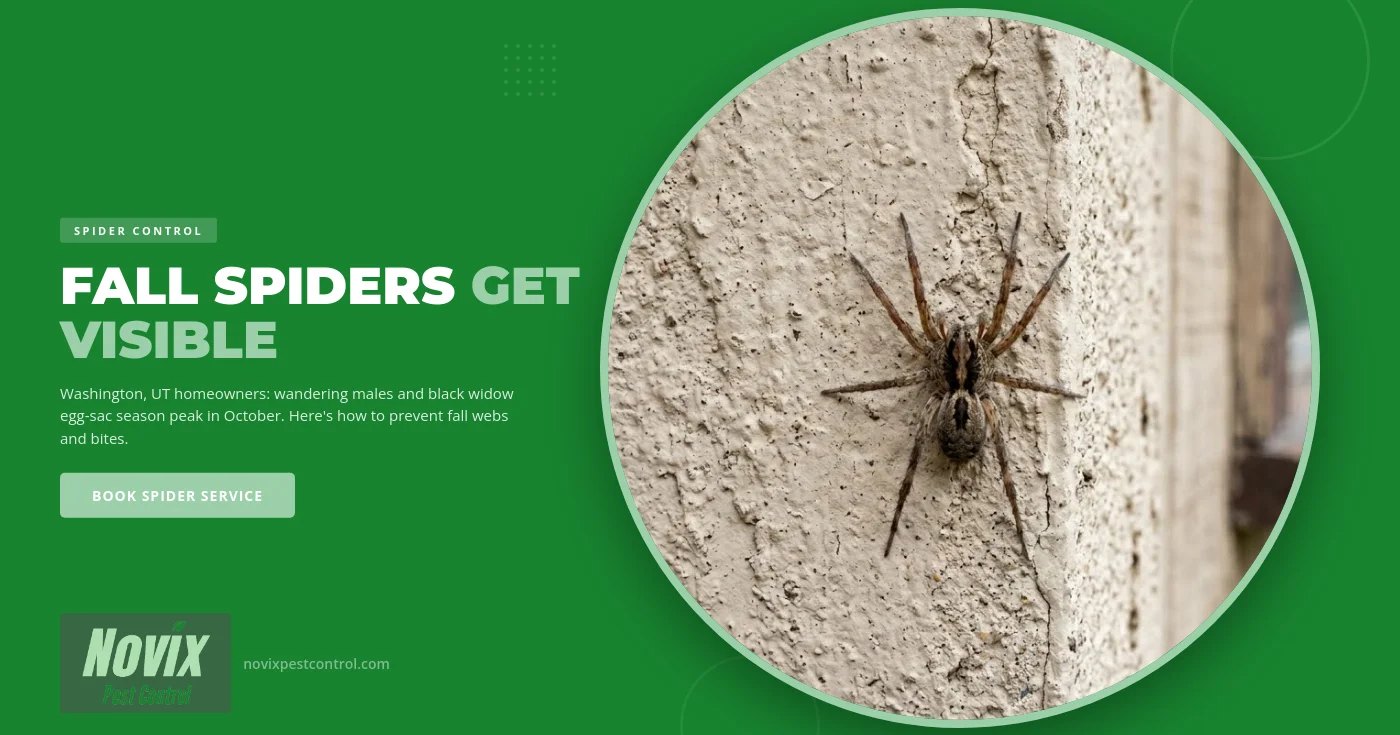
- Wolf spiders. Large, fast ground hunters that do not build webs. Females carry a round, cream-colored egg sac on the spinnerets, and spiderlings ride on the female's back for one to two weeks after hatching.
- Orb weavers (banded and cat-face varieties). The large, visually striking spiders that build wheel-shaped webs between patio posts, hose reels, and shrub branches. Peak size and visibility in October.
- Yellow sac spider (Cheiracanthium). A small, pale yellow or straw-colored spider frequently seen indoors across southern Utah. Builds a silk retreat in wall-ceiling corners and behind picture frames.
- Desert tarantula (Aphonopelma spp.). Primarily outdoor, but mature males migrate across desert terrain in late September and October and occasionally cross residential properties on the Washington outskirts.
Notably absent are true recluse spiders — the brown recluse is not established in Utah, and brown desert recluse sightings in southern Utah are rare and often misidentified crevice weavers. If you believe you have a recluse, submit a photo to our team or the Utah Plant Pest Diagnostic Lab before treating.
Black Widow Spiders: Identification and What to Watch For in Southern Utah
The western black widow is the single most important spider for a Washington, UT homeowner to recognize. Washington County sits inside the species' core range, and the dry, warm climate across the St. George corridor produces strong year-round populations that peak in fall.
Mature female identification:
- Body length roughly 1/2 inch, with a total leg span closer to 1.5 inches.
- Glossy, jet-black body, with a round, bulbous abdomen that gives her a distinctive "shiny marble" look.
- Bright red or red-orange hourglass marking on the underside of the abdomen — the single most reliable identification mark. On rare individuals the hourglass is broken into two triangles, but the color and underside position are consistent.
- Web is a messy, three-dimensional cobweb built close to the ground in a dark, undisturbed corner — distinctly different from an orb weaver's wheel-shaped web and a crevice weaver's wool-like sheet.
Males and juveniles are smaller, lighter (tan, brown, or patterned), and not generally medically significant. Juveniles pass through several patterned instars before darkening to adult female black.
Where western black widows establish in Washington, UT homes:
- Window wells — the single most common harborage we identify on fall service calls.
- Garage corners, especially behind stored boxes, inside unused flower pots, and at the garage door frame junction.
- Under exterior patio furniture — chair-seat undersides and the hollow legs of patio tables.
- Inside electrical and irrigation meter boxes at the property perimeter.
- Woodpiles, decorative landscape stone, and block-wall weep holes.
- Beneath exterior stairs, deck undersides, and children's play structures that sit directly on gravel.
- Rodent burrow entrances along block walls — a common secondary harborage after a rodent run has been excluded.
A western black widow bite causes a condition called latrodectism — significant muscle pain, cramping, abdominal rigidity, sweating, elevated blood pressure, and in some cases nausea or difficulty breathing. The bite warrants prompt medical attention, particularly for young children, older adults, and anyone with cardiovascular conditions. Do not attempt to catch or crush a confirmed western black widow — document it with a photograph and have our team handle the removal.
How to Reduce Spider Entry Points Around Your Washington, UT Home
Spider pressure is a direct function of two factors: harborage close to the structure and prey insects moving through the perimeter. Both are addressable from outside.
Reduce exterior harborage.
- Move firewood, decorative landscape stone, and brick piles at least 20 feet from the foundation and elevate firewood off the ground on a rack.
- Clear leaf and bark debris out of every window well and install a hardware-cloth cover rated for debris exclusion. This single step reduces fall black widow pressure on a Washington home more than any other.
- Trim vegetation to maintain at least 18 inches of air gap between plantings and the exterior wall.
- Clean the dead frond layer out of any palm skirts — palm skirts shelter both spiders and the prey that attract them.
- Reorganize storage under decks, exterior stairs, and play structures so there is airflow and visibility underneath.
Seal entry points.
- Replace worn garage door bottom seals. Any visible daylight at the corners means spiders and the insects they follow are coming through.
- Install rodent-and-insect-rated covers on stucco block-wall weep holes.
- Caulk around utility penetrations, hose bibs, HVAC line sets, dryer vents, and the gaps where exterior conduit enters the stem wall.
- Check weather stripping on exterior doors each fall and replace any gasket that no longer compresses when the door closes.
- Repair torn window and door screens before October.
Reduce prey-insect attraction.
- Replace white exterior bulbs with yellow sodium-vapor or warm-tone LED bulbs that attract fewer night-flying insects.
- Pull porch and patio lights off dusk-to-dawn timers in favor of motion sensors where practical.
- Address any standing water near the foundation — leaking drip emitters, pool deck pooling, and clogged downspouts.
These three categories handle roughly 70 to 80 percent of the preventable spider pressure on a typical Washington, UT property. The remaining 20 to 30 percent is where professional treatment makes the measurable difference.
DIY Prevention vs. Professional Spider Treatment: What Works in Washington, UT
Homeowner prevention is highly effective at the exterior and landscape level — the exclusion and harborage reduction above are work most Washington homeowners can execute in a weekend. Where the DIY ceiling becomes visible is in three areas our team addresses on every fall spider program.
Residual exterior perimeter treatment. Over-the-counter sprays break down within days under the Washington UV load. Our professional residual products deliver six to eight weeks of coverage on the foundation, eaves, window and door frames, and garage perimeter — long enough to handle both the male-wandering wave and the ongoing egg-sac hatch through November.
Species-targeted de-webbing and egg-sac removal. A homeowner can knock a web down with a broom, but a western black widow egg sac requires careful physical removal rather than crushing — a crushed sac disperses viable eggs. Our technicians de-web the full exterior and bag every reachable sac.
Property-specific harborage identification. Spider harborage patterns repeat year over year on a given property. The window well that produced a black widow in one October will almost certainly produce one next October unless the conditions change. We document each window well, garage corner, patio underside, and meter box producing activity so each follow-up visit works a shortening list.
For homes with children, pets, outdoor entertaining spaces that abut landscape beds, or any confirmed black widow activity, a professional spider control program in Washington, UT is the lowest-friction way to hold pressure down through the fall peak.
Contact Novix Pest Control for Spider Control in Washington, UT
At Novix Pest Control, our spider control program in Washington, UT runs in three connected phases — because spot treatments rarely hold against a desert property with established harborage.
Property walk and species identification. Our licensed technicians walk the full exterior in a fixed pattern: foundation, eaves, window wells, garage perimeter, patio and deck undersides, meter boxes, and exterior storage. We confirm the species, document every active web and egg sac, and flag the exact harborage locations.
Residual exterior treatment plus de-webbing. Targeted residual application on the foundation band, eaves, window and door frames, garage perimeter, and the harborage locations identified in the walk. Full de-webbing with careful physical removal of reachable egg sacs — including any confirmed western black widow sacs in window wells, garage corners, or meter boxes.
Follow-up and ongoing coverage. Spider work is maintenance work in Washington, UT. Our quarterly residential pest control program keeps your property's known harborage locations under active watch so each visit catches the next cycle earlier than the last. The scorpion control program runs alongside spider control on the same visit for homeowners dealing with both pressures.
Our team serves Washington, St. George, Ivins, Santa Clara, Leeds, and the greater southwestern Utah region with a 4.8-star reputation across Washington County — licensed, insured, and experienced with the specific black widow pressure patterns of the fall peak.
If you have spotted webs returning to the same corners, found an egg sac in a window well, or confirmed a western black widow near a patio or garage, our team can build a spider control plan tailored to your Washington home. Reach out to schedule your inspection with Novix Pest Control.
How Do I Stop Fall Spider Activity in Washington, UT?
Fall drives western black widows and wandering male spiders into Washington, UT homes. Cooler overnights, dying outdoor prey insects, and peak egg-sac season push harborage pressure toward window wells, garage corners, patio undersides, and meter boxes across the greater St. George area.
At Novix Pest Control, our spider pest control service for southwestern Utah properties is built around three connected phases:
- Property walk and species ID: Western black widows, crevice weavers, wolf spiders, and orb weavers each get handled differently. We confirm what we are dealing with and flag harborage in window wells, garage corners, patio undersides, and meter boxes.
- Residual exterior treatment with de-webbing: Targeted residual application on the foundation band, eaves, window and door frames, and garage perimeter — six to eight weeks of coverage. Full de-webbing with careful physical removal of egg sacs.
- Follow-up on known harborage: Quarterly check-ins on the window wells, garage corners, and meter boxes that produced activity so each visit works a shortening list.
If you have spotted webs returning to the same corners, found an egg sac in a window well, or confirmed a western black widow on your Washington property, our team can put together a plan tailored to your home. Reach out to schedule your inspection.