
Why Washington, UT Scorpions Stay Active Into Fall — And How to Protect Your Home
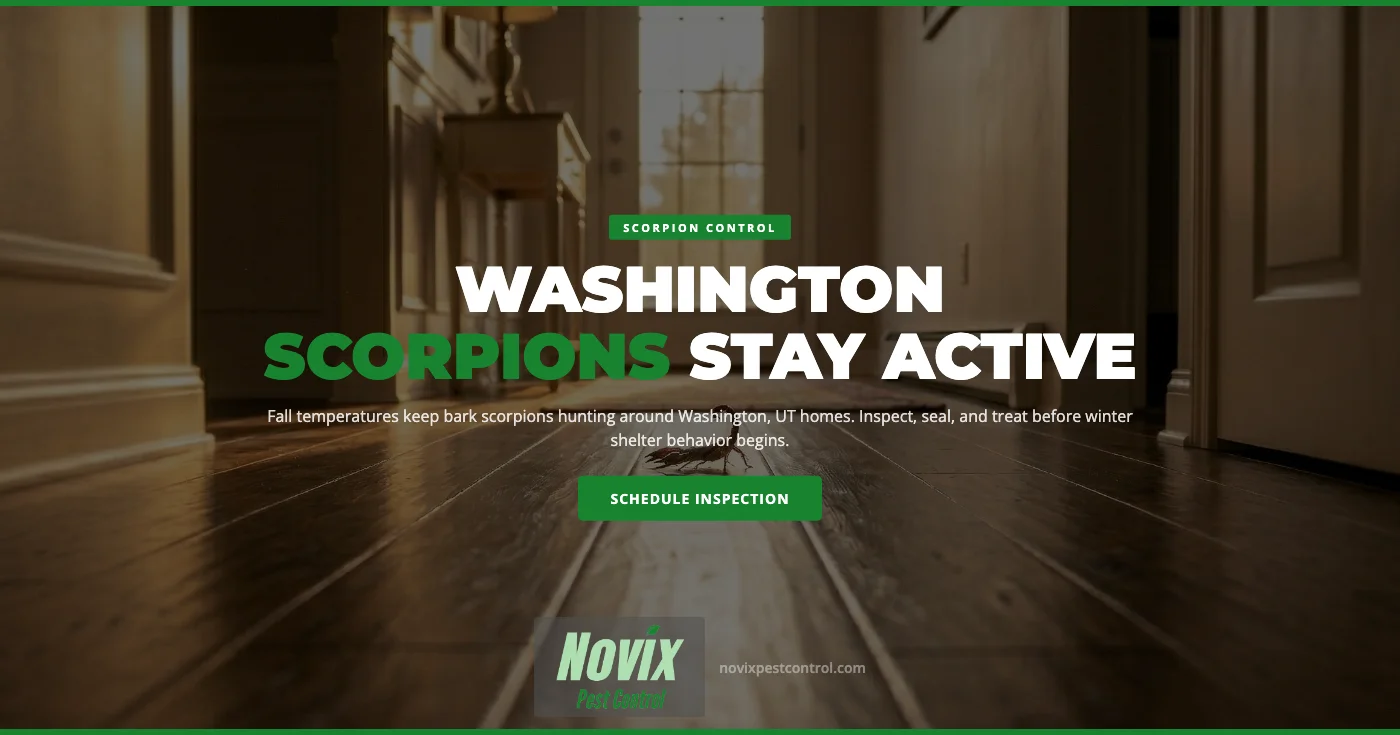
Why Washington, UT Scorpions Stay Active Into Fall — And How to Protect Your Home
By early September in Washington, UT, the peak summer heat has softened. Daytime highs still push into the low 90s, but overnight lows are dropping back into the 60s, and the monsoon storms of July and August have left irrigation lines, mulch beds, and rock landscape voids holding moisture the desert wouldn't normally carry into fall. That shift doesn't send scorpions away — it changes when they hunt, how far they travel, and where they end up. Homeowners across Washington, Coral Canyon, and the Green Springs corridor typically see a second wave of activity through September and October, well after they thought scorpion season was behind them.
If you're spotting scorpions on the patio at night, finding them curled in a shoe in the garage, or noticing them fluoresce green under a UV flashlight along the block wall, you're seeing the late-season pattern every southern Utah exterminator watches for. This guide covers why scorpion activity in Washington, UT stays elevated after summer, where scorpions concentrate on desert properties, and how our team at Novix Pest Control approaches scorpion control in Washington, UT.
Do Scorpions in Washington, UT Stay Active After Summer?
Yes — and understanding why matters more than the calendar. Scorpions don't migrate and they don't stop feeding when summer ends. Three species regularly turn up on Washington, UT properties, and each one shifts its behavior a little differently as fall arrives.
Arizona bark scorpion (Centruroides sculpturatus) is the species that drives most professional scorpion calls in Washington County. Adults run about two to three inches long and are yellowish-tan with slender pincers and a thin tail. Bark scorpions are the only scorpions in the desert Southwest that regularly climb — up stucco walls, block-wall fences, tree bark, palm skirts, and up into attic spaces through weathered vent screening. Their venom is neurotoxic, and stings warrant medical attention, particularly for young children, older adults, and anyone with underlying health conditions.
Desert hairy scorpion (Hadrurus arizonensis) is the largest scorpion in the region, running four to six inches long with a yellow body, dark back, and bristly hair on the tail. Despite the size, its sting is comparable to a bee sting for most people. Desert hairies are burrowers rather than climbers, and turn up on Washington, UT properties in decorative rock, along block-wall bases, and in the loose desert soil around foundations.
Northern scorpion (Paruroctonus boreus) is smaller at about two inches, more tolerant of cooler temperatures, and pushes its season deeper into fall — appearing in Washington yards well into October most years.
Per Utah State University Extension, scorpions remain active anywhere daytime and overnight temperatures stay above their tolerance threshold — and in the low desert around Washington, that window doesn't fully close until November.
Why September Scorpion Activity Stays High in Southern Utah
Three drivers keep scorpion pressure elevated through September and often into October across Washington, UT and the greater St. George area.
Overnight temperatures finally match scorpion preference. Scorpions are ectothermic and hunt most efficiently when night-time air temperatures sit between about 70°F and 85°F. Through July and early August in Washington, UT, overnight lows in the upper 70s and low 80s pushed some individuals to shorter, more concentrated hunts. September's cooler nights let scorpions range longer and stay active for a larger share of the dark hours.
Monsoon-fed prey populations peak. Scorpions eat crickets, roaches, spiders, beetles, and other arthropods — all of which surge during and immediately after monsoon storms. September activity reflects the previous six to eight weeks of moisture: irrigation-fed lawns, mulch beds, and drainage swales that filled repeatedly through August produce dense insect populations, and scorpions concentrate where their food does. Southern Utah University biology professor Bill Heyborne, quoted in St. George News, notes that scorpions are drawn to properties by insect prey and access to water — both of which persist well past the last monsoon cell.
Pre-winter feeding and sheltering. Bark scorpions and northern scorpions both aggregate through fall, sometimes in groups of 20 to 40 individuals sharing a single sheltered space through the coldest months. September and October are when those aggregations start assembling — which means individual scorpions are moving more than usual as they test wall voids, block-wall gaps, attic vents, and expansion joints for a suitable overwintering site. A Washington, UT homeowner who saw two scorpions all summer may see six in September as the pre-hibernation search intensifies.
Where Scorpions Hide in and Around Washington, UT Homes
Because bark scorpions climb and desert hairies burrow, a Washington, UT property offers dozens of viable harborage sites. The following categories cover almost every scorpion we recover during inspections.
- Block-wall bases and expansion joints: Southern Utah's ubiquitous CMU perimeter walls are the single most reliable scorpion shelter on any property. Voids between blocks, expansion joints, and cracked mortar hold cool humid air scorpions favor.
- Decorative rock and boulder groupings: Xeriscape features around foundations, entryways, and pool areas create shaded voids scorpions treat as ready-made dens. The larger the boulder and the closer to the exterior wall, the higher the shelter value.
- Palm skirts and unpruned trees: Bark scorpions climb into skirted palms and dense foliage that touches the roofline, using them as ladders into eaves and attic spaces. Palms with several years of dead frond skirt are the most productive scorpion habitat on many Washington, UT properties.
- Wood piles, scrap lumber, and stored building materials: Stacked firewood against the house, leftover framing lumber under a patio cover, and stored decking materials all provide the shaded, undisturbed harborage bark scorpions and desert hairies both prefer.
- Attic and wall voids: Bark scorpions climb weathered stucco, cross soffit vents, and drop into attics. Wall voids reached through weep holes and unsealed utility penetrations hold both bark and northern scorpions.
- Garages, sheds, and stored vehicles: Bark scorpions climb into garages through weathered door seals and settle in stored boxes, coiled hoses, and the underside of stored bikes, coolers, and side-by-sides.
- Interior low-traffic spaces: Once indoors, bark scorpions concentrate in closets, laundry rooms, guest bathrooms, and behind furniture in seldom-used rooms.
Scorpions fluoresce blue-green under 365nm ultraviolet light, which is why professional inspections rely on UV blacklight sweeps after dark. A UV walk-through can locate a dozen scorpions in an hour that a daytime visual inspection would miss entirely.
How to Reduce Scorpion Harborage Around Your Property
Reducing scorpion pressure starts with the exterior — because scorpions that never reach the foundation wall never test the entry points beyond it. Four categories of landscape and yard maintenance produce the biggest reduction on Washington, UT properties.
Eliminate harborage against the house. Keep a clear zone of 18 inches to three feet between decorative rock, mulch, wood piles, and the exterior wall. Move stacked firewood and stored lumber at least 20 feet from the foundation. Break up boulder groupings that sit directly against block walls — the void between the boulder and the wall is prime scorpion shelter.
Manage vegetation contact. Trim shrubs, ornamental grasses, and low branches so nothing touches the exterior wall or roofline. Remove dead palm frond skirts entirely — the layered dead material inside a skirt is one of the most productive bark scorpion harborage sites in southern Utah landscaping. Prune canopy back from the roof by at least three feet.
Reduce prey supply. Scorpions concentrate where their food does — crickets, roaches, spiders, and other arthropods. Managing the exterior insect population, switching to yellow-spectrum bulbs (which draw far fewer flying insects than white LEDs), and clearing dense harborage pulls the prey base out from under the scorpion population.
Address moisture. Fix leaking hose bibs, drip line fittings, and evaporative-cooler condensate lines within a day of noticing them. Redirect irrigation and downspout flow well away from the foundation, and pull back mulch and decorative rock to let the soil against the house dry between waterings.
Scorpion-Proofing Tips for Washington, UT Homeowners
Once exterior harborage is under control, structural sealing determines whether scorpions that reach the wall get inside. Bark scorpions can slip through openings as thin as a credit card, so exclusion work needs to be thorough — a partial job typically produces about the same indoor sightings as no exclusion at all.
- Weep holes. The horizontal slots in stucco veneer are the single most common structural entry we find. Cover every weep hole with dedicated stainless steel weep-hole covers that allow airflow while excluding scorpions.
- Garage door seals. Weathered rubber sweeps fail at the corners first, and those gaps are wide enough for a bark scorpion to walk through. Replace weathered seals annually if scorpion pressure has been an issue.
- Utility penetrations. Caulk every gap where electrical, gas, water, cable, and HVAC lines enter the exterior wall — these openings are rarely fully sealed by original construction.
- Door thresholds and weather stripping. Install door sweeps on all exterior doors, including the garage-to-house door, and replace weather stripping that no longer contacts the door face cleanly.
- Attic and roofline penetrations. Screen attic vents, gable vents, ridge vents, and plumbing stack penetrations with fine stainless mesh. Bark scorpions routinely find their way into attics through failed vent screening.
- Foundation and stucco cracks. Seal cracks wider than a credit card's thickness. Pay particular attention to the transition between the concrete slab and the wall — a common gap on older Washington, UT construction.
- Interior habits. Shake out shoes, gloves, and towels stored in the garage before use. Pull beds a few inches away from the wall, and reduce clutter in closets and low-traffic rooms.
Homeowners can supplement professional work with a 365nm UV flashlight — inexpensive, widely available, and effective. A twenty-minute weekly UV sweep of the block-wall perimeter, patio, and garage floor after dark catches most scorpions before they find their way inside.
When to Call a Professional Scorpion Control Service in Washington, UT
DIY scorpion management can hold a low-pressure property in check when exterior harborage and structural sealing are addressed thoroughly. But a few conditions reliably produce a faster, more durable outcome with a professional plan.
Reach out to a professional exterminator when you notice:
- Multiple scorpion sightings on the property over a short period — a strong indicator of active aggregation.
- Any interior sighting, particularly in bedrooms, children's rooms, or on flooring near sleeping areas.
- Bark scorpions confirmed on the property. Per the University of Utah Poison Control Center, bark scorpion stings can produce agitation, involuntary muscle movement, drooling, and breathing difficulty — particularly in young children — and warrant an immediate call to Poison Help.
- Persistent activity after a season of DIY treatment — often a sign that repellent products have pushed the population deeper into wall voids rather than eliminating it.
- Recent construction or landscape disturbance nearby — new grading, block-wall repairs, or foundation work displaces established scorpion populations onto adjacent properties.
At Novix Pest Control, our licensed technicians handle scorpion control in Washington, UT as a three-part program. First, we walk the full property with UV blacklight sweeps after dark — interior, exterior, block-wall perimeter, garage, outbuildings, and attic spaces — to identify the species, map harborage, and locate every entry point. Second, we apply targeted treatment: perimeter applications along block walls and foundation zones, dust treatments in wall voids and attic spaces, and interior crack-and-crevice work where sightings have concentrated. Third, we address the structural and landscape conditions that draw scorpions in — the exclusion work most scorpion jobs skip, and the reason those treatments don't hold through the following season.
Our team serves Washington, St. George, Ivins, Santa Clara, Leeds, and the greater Washington County area with a 4.8-star reputation across southern Utah. Ongoing protection through our residential pest control program keeps exterior treatment, UV monitoring, and seasonal inspection running so pre-hibernation aggregations never build against the house. If you're seeing scorpions on the patio, hearing them mentioned by neighbors, or noticing that late-season second wave in Washington, UT this fall, reach out and our team will put together a plan tailored to your property.