Paper Wasp Season in Ivins, UT: Late May Nest Building
Paper Wasp Season in Ivins, UT: Late May Nest Building
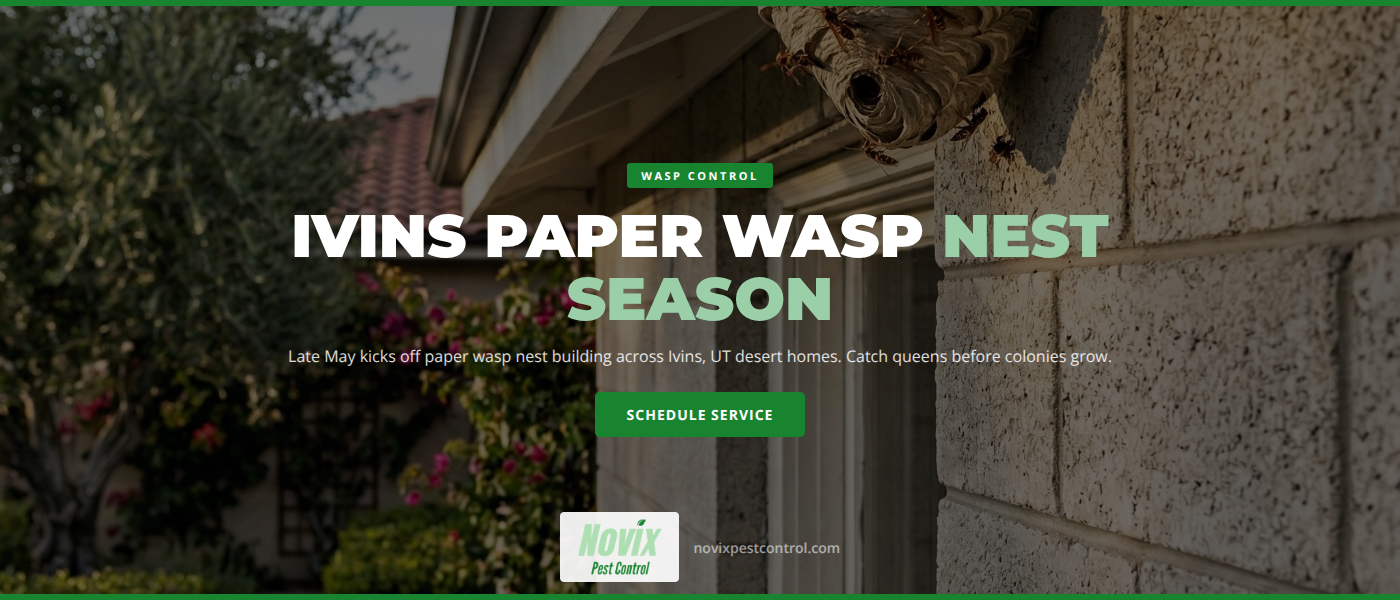
Late May is when paper wasp activity in Ivins, UT shifts from "occasional sighting" to active nest building. A queen that spent the cold months tucked into a wall void, attic eave, or shutter hardware is now hunting for a soffit corner or sheltered overhang to start her colony. Most Ivins homeowners don't notice until July — by which point the umbrella-shaped paper structure has 20 to 40 cells and a full guard of stinging workers.
At Novix Pest Control, we treat hundreds of paper-wasp nests across Washington County every year, and the calls that turn into the simplest jobs come in during this two-week window. If you're weighing options for wasp control in Ivins, UT, this guide covers why late May matters, where queens build, how to inspect your property, why store sprays often backfire, and how our team handles paper wasps the right way.
Why Late May Kicks Off Wasp Nest Season in Ivins, UT
Paper wasps don't establish colonies year-round — they follow a tightly seasonal cycle that tracks daytime temperature, daylight hours, and ground warmth. In Ivins, the calendar usually breaks down like this:
- October through March: Mated queens (foundresses) overwinter alone in protected spots — wall voids, attic vents, garage rafters, even outdoor furniture cushions.
- Mid-April through mid-May: Foundresses emerge on warm afternoons, scout sites, and often return to the same eave corner where a previous nest sat. (Paper wasps don't reuse old nests, but they recognize "good real estate.")
- Late May: Active construction. A foundress builds a few hexagonal cells, lays her first eggs, and begins the small solo phase of the colony.
- June through August: First worker brood emerges, the nest expands rapidly, and the queen retreats to egg-laying full time.
- September through October: New reproductives leave to mate; the original colony dies off.
Late May matters for Ivins homeowners because a nest in the solo-foundress phase is small, isolated, and not yet defended by workers. The same nest in July is a different animal — louder, faster, and willing to defend a territory of several feet around the structure.
How Paper Wasp Queens Choose Nest Sites on Desert Homes
Paper wasps belong to the genus Polistes — Utah hosts both native species and the invasive European paper wasp (Polistes dominula). According to Utah State University Extension, European paper wasps are now common statewide and well adapted to suburban construction — which matters in Ivins because newer subdivisions with stucco, deep eaves, and shaded patio overhangs offer almost ideal Polistes habitat.
A foundress is looking for four things when she picks a nest site:
- Overhead shelter from sun and rain: An umbrella-shaped paper nest has no outer envelope — the open hexagonal cells are exposed, so the queen needs the structure itself to act as a roof.
- Shade for most of the day: Direct desert sun at 100°F will overheat the brood. South- and west-facing exposures get used only when something blocks afternoon sun.
- Low foot traffic: Queens avoid sites that vibrate or get jostled. A back-of-house eave is preferred over a front-porch ceiling.
- A short, solid attachment point: Stucco corners, vinyl soffit seams, wood beams, light-fixture brackets, and metal door frames all give the stalk something rigid to grip.
On Ivins homes specifically, red-rock landscaping, stucco exteriors, and deeply shaded patios produce a lot of qualified candidates. We routinely find nests starting on covered patios, RV-port ceilings, pergola crossbeams, garage door tracks, and the underside of solar panels.
Hidden Spots to Inspect on Your Ivins Property This Week
A 10-minute walk around your property in late May catches almost every early nest. The nest is still small — a single layer of 5 to 15 cells the size of a quarter — and the queen is the only adult present. Bring a flashlight and check:
- Soffits and eave corners: The single most common location. Check every corner where two soffit pieces meet, especially on shaded sides.
- Porch and patio ceilings: Covered patios in Ivins are prime habitat. Walk the perimeter and look straight up.
- Door and window frames: The top inside corners of exterior frames are a Polistes favorite — sheltered, smooth, and warm.
- Pergolas and shade structures: The underside of any crossbeam or lattice, particularly on the west side where evening shade gathers.
- Light fixtures and ceiling fans: Outdoor sconces, porch ceiling fans, and recessed can lights provide warmth and shelter.
- Outbuildings and sheds: Open rafters, the underside of metal roof panels, and the back of hanging tools.
- Storage and play equipment: Grill covers, upright patio cushions, unused planters, ATV seats, and the underside of slides or swing-set crossbeams.
A small, gray, papery structure with visible hexagonal cells hanging from a short stalk is a paper wasp nest, and a single queen will usually be on or beside it. Don't disturb it — note the location, walk away, and decide your next step.
Why DIY Wasp Spray Often Makes Nests More Aggressive
Hardware-store wasp sprays advertise distance and quick knockdown, and on a small starter nest with one queen, sometimes that's enough. The problem is the same can performs badly on the nests homeowners actually call about — June, July, and August nests already holding 20 to 200 workers. Here's what tends to go wrong:
- Stream length oversells: The "20-foot stream" carries straight up to about half that once wind and drift are accounted for. Homeowners end up much closer than expected.
- The colony bolts before it drops: Pyrethroid sprays take seconds to incapacitate. Workers leave the nest in those seconds and head outward — toward the person spraying, pets, or the open garage.
- Surviving workers regroup: Polistes wasps that aren't directly soaked return to the site within hours. Without removing the nest itself, the colony rebuilds.
- Foam can mask the queen: Some products encase the nest in foam — visually satisfying, but the queen often survives inside the cells and the homeowner walks away thinking the job is done.
- Allergic reactions are unforgiving: Paper-wasp stings drive a meaningful share of anaphylaxis ER visits in the Southwest, and a scattered colony stings repeatedly as the alarm pheromone spreads.
USU Extension's guidance on wasps is direct: work in early morning before adults leave the nest, wear a bee veil and gloves, and use a residual product. Most homeowners aren't set up for that — which is the practical reason wasp control in Ivins, UT is one of our most common June and July calls.
How Novix Removes Wasp Nests the Right Way in Southwest Utah
Our paper-wasp workflow is built around two principles: hit the nest when activity is lowest, and remove the structure so the colony can't rebuild. A typical Ivins call runs through:
- Property walk and ID: Paper wasp, yellow jacket, mud dauber, and bald-faced hornet all get treated differently. We confirm the species first.
- Timing the application: When the schedule allows, we treat in the cooler part of the day when workers are clustered on the nest — a single change that dramatically reduces airborne wasps.
- Direct nest treatment with residual: A targeted application hits the cells and the queen; the residual handles foragers returning over the next 24 to 48 hours. Products are chosen for low odor and short reentry intervals.
- Physical removal: Once activity has stopped, the nest is removed and the attachment point wiped down. Pheromone residue lures new queens next season, so cleaning the spot matters.
- Perimeter exterior treatment: An eave-line residual on the entire structure suppresses new foundress activity through peak nest-building — usually six to eight weeks of coverage.
- Property recommendations: If an eave, light fixture, or shed corner keeps producing nests year over year, we flag the physical fix — sealing a soffit gap, swapping an exterior bulb, changing storage placement.
We're licensed and insured, and wasp work runs as part of our broader residential program. Our team holds a 4.8-star reputation across Ivins, St. George, Washington, Santa Clara, and the rest of Washington County — a lot of which comes from handling stinging insects without turning a small problem into a stung-homeowner problem.
When to Schedule Wasp Prevention Before Summer Activity Peaks
Paper-wasp work in Ivins follows a predictable seasonal calendar, and the same job costs less time and stress in May than in July. Here's how we frame the timing:
- Late May (this window): Foundress phase. Most nests are quarter-sized or smaller and have no workers. Treatment is fast and a perimeter application carries protection deep into summer.
- Early to mid-June: First worker brood emerging. Nests are still manageable, but treatments need more residual product and the visible "active wasp count" climbs week over week.
- July and August: Peak activity. Nests of 100 to 200 workers, defensive radius of several feet, and a higher chance of repeat treatment. Almost all of our emergency wasp calls fall in this window.
- September: New reproductives leaving the nest and colonies dying off naturally. We still treat structures with visible nests, but the urgency drops.
If you've had paper wasps on your Ivins property in past seasons, the most reliable move is a single late-May visit that catches whatever starter nests exist and lays down perimeter coverage on the eave line. Homes on a recurring quarterly program rarely see active wasp nests — the same residual that handles ants and spiders suppresses foundress activity through spring.
Frequently Asked Questions About Wasp Control in Ivins, UT
How do I tell a paper wasp nest from a yellow jacket or hornet nest?
Paper wasps build open, umbrella-shaped nests with visible hexagonal cells hanging from a short stalk — almost always under an overhang. Yellow jackets nest in the ground or wall voids and the nest itself is rarely visible. Bald-faced hornets build large, fully enclosed gray paper balls usually in trees or on a building exterior. The treatment approach is different for each, which is why species ID matters first.
Will paper wasps sting if I leave the nest alone?
Paper wasps are less aggressive than yellow jackets and generally only sting when the nest is threatened, jostled, or approached within a couple of feet. The trouble is that "approached within a couple of feet" describes nearly every routine activity on an Ivins patio — grilling, sitting under the pergola, opening the back gate, getting kids in and out of the pool. Once a nest sits in a high-traffic area, removal makes practical sense.
Why do paper wasps keep coming back to the same spot on my house?
The location worked once — the shelter, shade, and attachment surface that drew one queen will draw another. Pheromone residue on the original site also lasts months, and new foundresses use scent as a shortcut for site selection. Cleaning the spot after removal and adjusting structural factors (a soffit gap, a porch light running all night) reduces repeat infestations.
How long until wasps are gone after a professional treatment?
Workers on the nest at the time of treatment are eliminated within minutes. Foragers returning over the following 12 to 24 hours encounter the residual and are eliminated then. By the second day, the nest is generally inactive and can be removed. Perimeter residual continues to suppress new foundress activity for six to eight weeks.
Get Ahead of Paper Wasp Season in Ivins, UT
Late May is the cleanest window of the year to handle paper wasps. Starter nests are small, queens are alone, and a single visit knocks down what would otherwise become a July emergency. The longer that visit waits, the bigger the colony — and the more disruption the eventual treatment creates.
If you've spotted a small umbrella-shaped nest, noticed a queen patrolling a soffit corner, or simply want to head off paper-wasp activity before summer takes off, our team can put together a plan tailored to your property. Learn more about wasp control in Ivins, UT and reach out to schedule a visit — we serve Ivins, St. George, Washington, Santa Clara, and the surrounding desert communities.