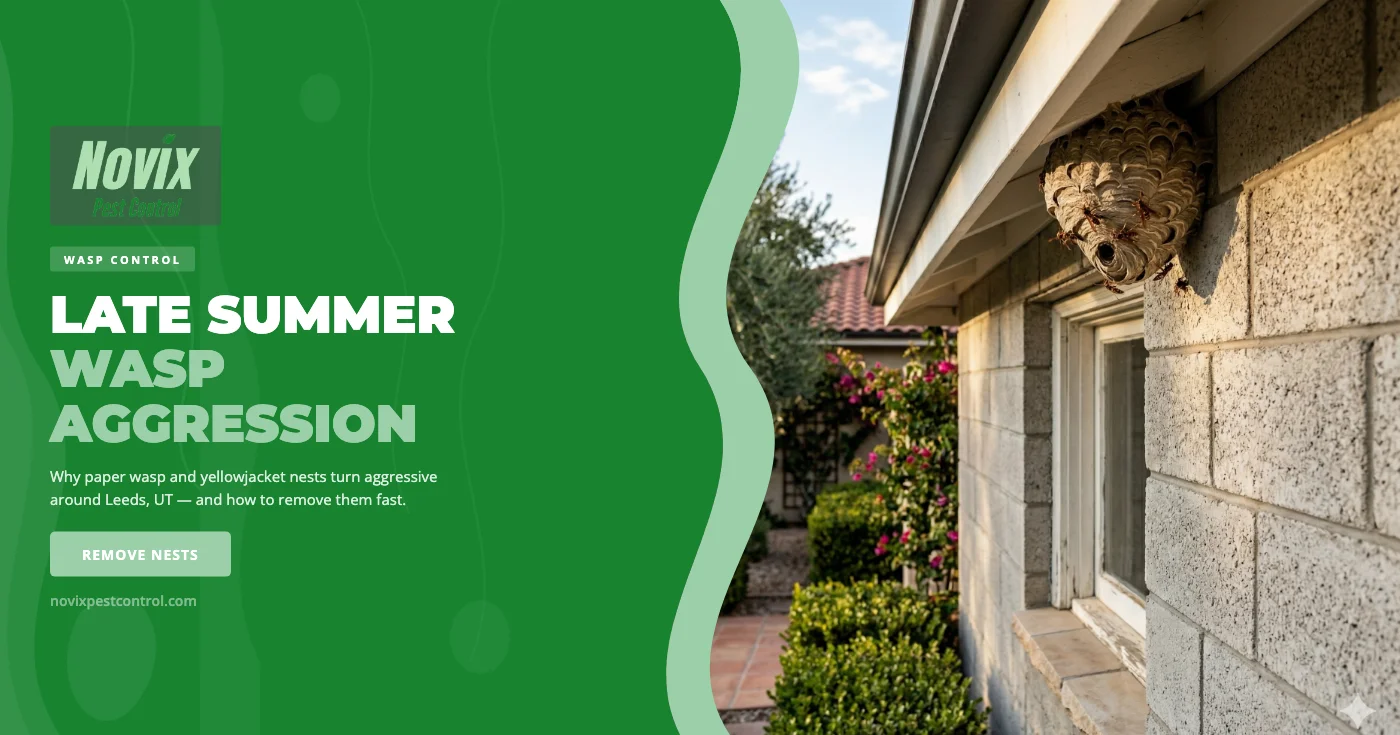
If you've noticed more wasps buzzing around your patio, trash cans, or backyard barbecue this month, you're not imagining it. Late summer is when wasp activity peaks across Leeds, UT — and it's also when nests turn noticeably more defensive. Paper wasps and yellowjackets that shared your yard peacefully in June and July can become surprisingly quick to sting in August and September. At Novix Pest Control, we field a sharp uptick of wasp calls from Leeds homeowners every year around this time, and the reason has everything to do with what's happening inside those nests right now.
Why Wasp Nests Turn Aggressive in Late Summer
Paper wasp and yellowjacket colonies follow a predictable annual cycle. A single overwintered queen starts a small nest in spring, raises the first few workers, and then hands off foraging duties as the colony grows through early summer. By late July and August, those Leeds nests have reached peak population — often several hundred paper wasps in a single umbrella nest, or several thousand yellowjackets in a well-established ground colony.
The behavioral shift homeowners notice comes from three factors converging at once. First, the sheer number of workers on patrol is at its highest. Second, the colony has shifted its focus from raising workers to raising next year's reproductive queens and males, which means less larval food is being produced inside the nest — and worker wasps that depended on larval secretions for sugar now scour the outside world for it. Third, the queen's egg-laying slows, which changes the chemistry inside the nest and leaves workers restless and easily provoked.
That combination is exactly why a wasp that would have flown past you in June may now dive-bomb your soda can or sting when you step within four feet of an eave in Leeds. The wasps aren't behaving irrationally — they're at the tail end of a season-long buildup, defending a large investment with a large workforce and a shortening runway.
Paper Wasps vs. Yellowjackets: What Leeds Homeowners See in August
Not every stinging insect around your Leeds property is the same species, and knowing what you're dealing with matters for both risk and treatment. In our work across Leeds and the surrounding Southern Utah region, two species dominate late-summer service calls.
Paper wasps — most often the western paper wasp (Polistes aurifer) here in Utah — build the familiar upside-down umbrella nests you see hanging under eaves, soffits, patio covers, and playground equipment. The nest cells are open and exposed, and mature colonies typically number 50 to 200 wasps. Paper wasps are generally less aggressive than yellowjackets, but a late-summer paper wasp colony will still defend its nest quickly if you get within a few feet.
Yellowjackets are a much bigger problem in Leeds during August. They build large, enclosed paper nests inside rodent burrows underground, in wall voids, in attic vents, or in dense shrubbery. A single yellowjacket nest in Southern Utah can hold 1,500 to 5,000 wasps by August, and unlike paper wasps, yellowjackets are scavengers — they're the ones dive-bombing your trash cans, hovering around meat on the grill, and following your kids' juice boxes around the yard.
According to the UC Statewide IPM Program, yellowjackets can sting repeatedly and are responsible for the majority of stinging insect incidents in and around homes during late summer, making them the higher-priority target for Leeds homeowners heading into August and September.
Where Nests Hide Around Southern Utah Homes
One of the most useful things a Leeds homeowner can do in early August is a careful walk around the property looking for active nests. Paper wasp nests are usually the easier find because the umbrella structure is visible. Yellowjacket nests are trickier — they often reveal themselves only through the traffic of workers coming and going from a small opening.
Common paper wasp nest locations we find on Leeds homes include:
- Under eaves and soffits, particularly on the shaded north and east sides
- Inside patio covers, pergolas, and gazebos
- Under deck railings and porch overhangs
- In and around playhouses, sheds, and outdoor storage structures
- Behind exterior shutters and light fixtures
- Inside grill covers and rarely used outdoor equipment
Common yellowjacket nest locations in Leeds include:
- Abandoned rodent burrows in the yard, often near landscape edging or rock features
- Wall voids accessed through a small gap in siding, vents, or trim
- Attic spaces entered through soffit vents or gable vents
- Underneath railroad ties, decorative rocks, or dense ground cover
- Inside compost bins or wood piles that have gone undisturbed for months
If you see steady wasp traffic focused on a single point on your Leeds home or yard — particularly a small hole in the ground or a gap in siding — that's a strong indicator of an active nest. Mark the spot from a distance and step back. Getting closer to confirm is not worth the risk once colonies have reached late-summer size.
The Risks of Knocking Down a Nest Yourself
Every August we get calls from Leeds homeowners who tried to handle a nest themselves and ended up in urgent care or worse. The impulse is understandable — a can of aerosol from the hardware store is inexpensive and the label promises fast results — but late-summer wasp encounters are a different situation than early-season swatting.
Yellowjackets in particular can sting many times per individual, and the colony's alarm pheromones bring reinforcements within seconds. A single misplaced spray can trigger a swarm response that pursues you 30 to 50 feet from the nest. For anyone allergic to stinging insect venom, even one sting can require an emergency response, and repeated stings from a defensive colony can send otherwise healthy adults to the hospital.
Physical risks compound the situation. Ladder work near an eave with an active paper wasp nest is a fall waiting to happen once wasps start defending. Ground-nest yellowjacket colonies often go unnoticed until a lawnmower or foot triggers a full response — and then the yard becomes a hazard zone for pets and children for hours. Utah State University's guide to paper wasps specifically recommends against DIY removal of large or hard-to-reach nests, and that guidance applies double for yellowjacket colonies in wall voids or underground.
Aerosol products also frequently miss the queen and interior brood, meaning the nest looks knocked down but rebuilds within days from surviving workers or nearby satellite groups. What starts as one wasp problem in July becomes three separate problems in August, and each new nest is harder to reach than the last.
Signs You Have a Growing Wasp Problem in Leeds
Not every wasp sighting in your Leeds yard means you need immediate service — a few paper wasps foraging around flowering plants is normal and generally welcome, since they're solid predators of caterpillars and other garden pests. But certain patterns should prompt a closer look and, in most cases, a call.
Steady traffic to a single point — whether that's a hole in the ground, a gap in your siding, an attic vent, or a shrub — is the clearest sign of an established nest. Watch for a minute from a distance. If wasps are entering and leaving in a consistent flight path, there's a colony behind that opening.
Wasps hovering around trash cans, recycling bins, or outdoor eating areas after mid-July is a strong yellowjacket indicator in Leeds. Paper wasps do not typically scavenge protein and sugar the way yellowjackets do, so trash-can activity almost always means a nearby yellowjacket colony.
Chewed-looking fascia or trim can indicate paper wasps stripping fiber from wood to build nest material. It's cosmetic damage rather than structural, but it points to nearby nest activity you may not have located yet.
Wasps inside your home — particularly in ceiling light fixtures, upper-story windows, or attic spaces — often means a wall-void or attic yellowjacket colony has found its way indoors. This is one of the most urgent scenarios we respond to for Leeds homeowners, because a nest venting into a living space can escalate fast.
Late-day dive-bombing near shaded sides of your Leeds home is a warning that a colony has grown large enough to post defenders well beyond the immediate nest perimeter. That's the moment to stop the wait-and-see approach and get a professional assessment.
How Novix Pest Control Removes Wasp Nests
At Novix Pest Control, our approach to wasp and yellowjacket removal is built around the specific conditions Leeds homeowners face in late summer. Southern Utah's climate, the mix of paper wasp and yellowjacket species we see here, and the construction styles common on Leeds properties all factor into how we plan and deliver treatment.
Our process starts with a thorough on-site inspection. We identify the species, locate the primary nest and any satellite activity, and assess how close the colony is to entry points, patios, kids' play areas, and pet zones. That inspection shapes a treatment plan tailored to your Leeds home rather than a one-size-fits-all approach.
Timing matters. We schedule most wasp treatments for early morning or evening, when workers are inside the nest and outdoor activity is at its lowest. That maximizes contact with the colony and minimizes risk for you, your neighbors, and our technicians. For ground-nesting yellowjacket colonies, we use direct-injection treatment methods that reach the interior of the nest where the queen and brood live — not just the visible entrance.
We use professional-grade wasp pest control products designed to eliminate the entire colony over 24 to 72 hours, including foragers returning to the nest after treatment. Once the colony is confirmed inactive, we can remove the physical nest from eaves, wall voids, or ground burrows to prevent secondary pest issues and to keep the same location from being reused next year.
We also handle beneficial pollinator situations differently. If your Leeds property has an established honey bee colony that's been misidentified as a wasp problem, we don't spray — we route it to appropriate bee removal resources so the colony can be relocated. Bees are protected in ways wasps are not, and our team knows the difference on sight.
After treatment, we walk Leeds homeowners through prevention steps for the coming weeks — sealing entry points, screening vents, managing trash, and setting up perimeter monitoring so a second colony doesn't move in before winter. Many of our Leeds clients also enroll in an ongoing protection plan that includes early-season queen suppression in spring, which prevents most nests from ever reaching the aggressive August size in the first place.
If you're seeing wasps around your Leeds home right now, don't wait for the problem to escalate. Reach out to Novix Pest Control today and let our licensed, experienced team put a plan together that gets the nest out and gives your family the peace of mind to enjoy the rest of the summer.