
How Pack Rats and Roof Rats Get Into Leeds, UT Homes as Fall Arrives
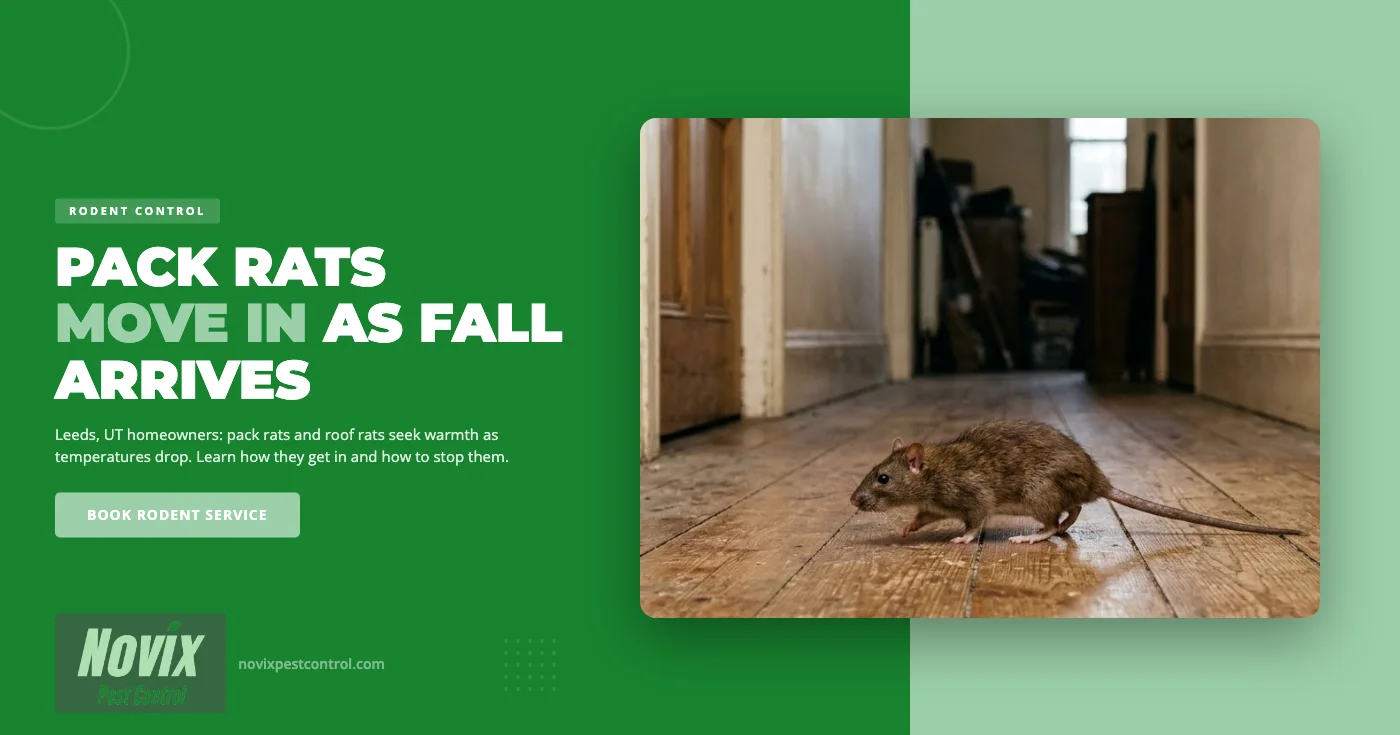
How Pack Rats and Roof Rats Get Into Leeds, UT Homes as Fall Arrives
By late September in Leeds, UT, overnight temperatures start slipping into the low 60s while daytime highs still cross into the mid 80s. To a pack rat curled in a boulder pile at the edge of your property, or a roof rat cruising a palm skirt three feet from your soffit, that shift is the annual cue to scout a winter shelter. Fall doesn't slow the rodent problem in Leeds, UT — it concentrates it, pushing pack rats out of exposed middens, drawing roof rats down from Aleppo pines and juniper stands, and sending both species toward the warmest, most reliable structures on any given street.
If you're seeing droppings on the garage floor, hearing scratching in the attic at 2 a.m., or spotting the twig-and-cactus-joint pile the neighbors have in their side yard, you're seeing the pattern our technicians work every fall across Leeds, St. George, Washington, Ivins, and Santa Clara. This guide covers what pack rats and roof rats are doing in Leeds, UT, how they get inside, what they damage, and how our team at Novix Pest Control handles rodent control in Leeds, UT.
Why Fall Drives Pack Rats and Roof Rats Into Leeds, UT Homes
Two rodents drive nearly every fall rodent control call our team runs in Leeds, UT and the wider St. George corridor: the desert woodrat, commonly called the pack rat, and the roof rat. They behave very differently, but both respond to the same seasonal pressure.
The desert woodrat (Neotoma lepida) is native to the Great Basin and the Mojave, and per DesertUSA, it's the species behind the classic packrat midden — a bulky pile of twigs, cactus pads, juniper branches, and shiny objects within dragging distance. Pack rats are strongly site-loyal; a single midden can persist through generations, meaning the pile you noticed against the block wall this fall likely started three or four years ago and simply became visible as vegetation thinned.
Roof rats (Rattus rattus) are the more recent arrival to Washington County. Local reporting documented a marked five-year increase in roof rat calls, with pest professionals reporting rat control call volumes climbing roughly 40% year over year across the greater St. George area. Roof rats are exceptional climbers — the University of California IPM Program's Pest Notes on rats confirms they routinely travel 300 feet or more between shelter and food and prefer nest sites well above ground level.
Three shifts every fall push both species harder toward Leeds homes:
- Cooler overnights. Pack rats and roof rats can't thermoregulate against extended cold outdoors the way they can under attic insulation or inside a wall void. The mid-September temperature drop is the trigger.
- Falling water availability. Southern Utah's dry fall follows a monsoon peak that briefly floods natural water sources; as those dry down, rodents move toward drip irrigation, pool decks, pet water bowls, and evaporative cooler pans.
- Pre-winter breeding. Female roof rats produce three to five litters between spring and late fall, and pack rat gestation runs 30 to 36 days. Both species prefer to raise late-season young in insulated, temperature-stable spaces — exactly what an attic provides.
The result is the pattern our licensed technicians see year after year: a slow rodent trickle through August that accelerates sharply across mid-September and holds through November.
How Desert Rodents Enter Your Leeds Home Through Common Openings
Rodents don't need a hole. They need a gap. UC IPM guidance states that a young rat can squeeze under a door with only a 1/2-inch clearance, and mice slip through anything larger than 1/4 inch. In practice, that means every rodent inspection our team runs on a Leeds property maps to the same handful of failure points.
Ground-level entries:
- Weathered garage door bottom seals. The rubber gasket at the base of an overhead garage door degrades in the desert sun in three to four seasons. Once daylight is visible under the door at either corner, rodents are already using that gap.
- Unscreened weep holes on stucco block walls. A direct pathway from a landscape bed into the wall cavity.
- Utility penetrations. HVAC line sets, gas lines, hose bibs, and dryer vent boots pass through the stem wall with gaps installers rarely finish tight enough for rodent exclusion.
- Foundation cracks. Cracks running along stem walls after monsoon soil movement widen enough for adult rats within a single season.
Elevated entries (roof rats):
- Palm skirts. Untrimmed palm fronds hanging over a roofline are a rodent highway. Roof rats travel the underside of the skirt onto the roof, then locate an attic vent, roof jack, or worn flashing seam.
- Attic and gable vents. Standard vents ship with mesh sized for airflow, not rodent exclusion — mesh openings often exceed 1/2 inch.
- Fascia and eave gaps. Where fascia meets the sub-fascia or where an eave transitions over a wall junction, thermal movement can open small gaps roof rats find and enlarge.
- Roof-to-wall junctions. Lower roof planes meeting higher walls — bump-outs, bay window roofs, garage-to-house junctions — create pinch points where flashing gaps become entry points.
During a rodent inspection in Leeds, UT, we walk the full exterior in a fixed pattern, note every gap wider than a pencil, and then map how those exterior gaps line up with interior sound and staining. That mapping — not the trap placement — is what makes a rodent job actually hold on a Leeds property.
Signs of a Rodent Infestation in Your Leeds, UT Property
Rodents are largely nocturnal, and by the time you're seeing one in daylight, the colony behind that one animal has typically been in place for months. Our technicians look for these earlier indicators during every rodent inspection in Leeds, UT:
- Droppings. Pack rat droppings are dark, capsule-shaped, roughly 1/4 to 1/2 inch long, and often piled near the midden. Roof rat droppings are longer, thinner, spindle-shaped with pointed ends. Mouse droppings are smaller — under 1/4 inch — and scattered in tight clusters near food. Never sweep dry droppings; the aerosol they raise is the primary carrier of concern for hantavirus.
- Middens. Pack rat middens are unmistakable — a bulky, tightly packed pile of twigs, cactus joints, juniper branches, and small foreign objects, typically at the base of a block wall, boulder pile, or under a stored vehicle. An established midden smells faintly musky from urine cementation.
- Rub marks and grease trails. Rats travel the same route repeatedly and leave dark, oily rub marks along baseboards, roof beams, and outdoor block-wall runs — the single most reliable indicator of a well-established route.
- Scratching or scurrying sounds. Attic and wall-void activity typically peaks between 9 p.m. and 4 a.m. Scratching over a bedroom ceiling on multiple consecutive nights is a strong indicator of a roof rat family group in the space.
- Chewed materials. Cardboard shredded into nest lining, chewed pet food or bird seed bags, and gnaw marks on soft plastic tubs are all common early evidence.
A single sign isn't a diagnosis. Two or more of these on a Leeds, UT property in September or October is a strong case for scheduling a professional rodent inspection before the fall pressure peaks.
The Damage Rodents Cause Behind Walls and in Attics
Rodents are more than a nuisance. On any given call in Leeds, UT, our team routinely documents three categories of damage that can quietly escalate into thousands of dollars in structural repair:
Chewed wiring. Rats and mice keep their incisors trimmed by chewing continuously. Romex, low-voltage transformer wiring, and thermostat runs are frequent casualties. Chewed conductors inside a wall are among the leading rodent-caused fire hazards on residential structures — and typically go unnoticed until an intermittent circuit or an odd burnt smell prompts a call.
Chewed water lines. Roof rats gnaw PEX and copper supply lines in attics with alarming frequency. A recent case in the greater St. George area produced a $59,000 attic flood from a single chewed supply line, followed by a second $24,000 flood after the initial repair — a case one local pest professional described as "the worst one I see, and I've seen that a lot."
Insulation contamination. Attic insulation absorbs rodent urine and feces over a season and loses much of its R-value. Contaminated insulation typically needs to be removed and replaced under CDC-aligned protocols rather than cleaned in place.
Health considerations. Deer mice sheltering alongside pack rats are the primary hantavirus pulmonary syndrome reservoir in the Four Corners region. The Centers for Disease Control and Prevention explicitly cautions against sweeping or vacuuming rodent nest material dry — the aerosolized dust is the transmission pathway. Any midden cleanup in a Leeds home should follow the CDC ventilate-and-wet-clean protocol, and our team handles that step as part of the removal phase.
Rodent Prevention Tips for Leeds Homeowners This Fall
Rodent prevention in Leeds, UT breaks into three connected efforts: exclusion, habitat modification, and monitoring. Our team walks homeowners through the same short list before every fall service:
Exclusion first.
- Seal every gap larger than 1/4 inch. Steel wool, hardware cloth (1/4-inch mesh), copper mesh, and sheet metal are the materials that hold; expanding foam alone will not.
- Replace worn garage door bottom seals every three to four seasons.
- Install rodent-rated weep hole covers on stucco block walls.
- Screen all attic and gable vents with 1/4-inch hardware cloth secured to the framing, and cap dryer, bath fan, and range hood vents with rodent-rated dampers.
Habitat modification.
- Trim any tree or shrub within four feet of the roofline back by two feet minimum. Palm skirts should be trimmed to remove the dead frond layer.
- Move firewood, decorative timbers, and stacked landscape stone at least 20 feet from the structure and elevate firewood off the ground.
- Store pet food, bird seed, and chicken feed in tight-fitting metal containers — plastic bins are only a delay.
- Pull pet water dishes inside overnight through fall, and repair leaking drip emitters near the foundation.
Monitoring.
- Walk the exterior once a month with a flashlight and look for fresh gnaw marks around utility penetrations and door bottoms.
- Set a single snap trap in the garage as an early-warning indicator; a catch there means the colony is close.
- Photograph any new droppings, midden material, or scratching sounds for reference before cleanup.
Leeds homeowners who work through this list before the mid-October push typically enter winter with the strongest chance of keeping rodents out of the attic entirely.
When to Call Novix for Professional Rodent Control in Leeds
At Novix Pest Control, our rodent control program in Leeds, UT is built around three connected phases — because trapping alone never holds against pack rats or roof rats on a desert property.
Inspection first. Our licensed technicians walk the full property in a fixed pattern: interior baseboards, garage, pantry, attic access points, exterior stem wall, roofline, block-wall perimeter, and every landscape harborage zone. We identify the species, map every active midden and travel route, photograph findings, and locate every entry point wider than a pencil.
Targeted removal and CDC-aligned cleanup. Snap traps and tamper-resistant bait stations placed along confirmed travel routes — not scattered on the assumption rodents will wander into them. Where middens are present indoors or in an attic, our team handles cleanup under CDC ventilate-and-wet-clean protocols with proper protective equipment, and contaminated insulation is removed and replaced rather than cleaned in place.
Structural exclusion. Hardware cloth, copper mesh, sheet metal, and structural sealants close off every gap identified during inspection. Exclusion is the part of the job most rodent services skip, and it's the reason they keep sending repeat truck rolls to the same house. Our team completes exclusion as part of the initial program, not as a separate upsell.
Ongoing residential pest control runs a quarterly perimeter check so any new gap, new midden, or landscape change that opens a new pathway is caught before the next fall rodent push. Our team serves Leeds, St. George, Washington, Ivins, Santa Clara, and the greater southern Utah region with a 4.8-star reputation across Washington County.
If you're seeing droppings, hearing scratching in the attic, or noticing that musky midden odor around your Leeds property this fall, our licensed team can build a rodent control plan tailored to your home. Reach out to schedule your inspection with Novix Pest Control.