
Why Harvest Ants Surge in Hurricane, UT Every September — And How to Control Them
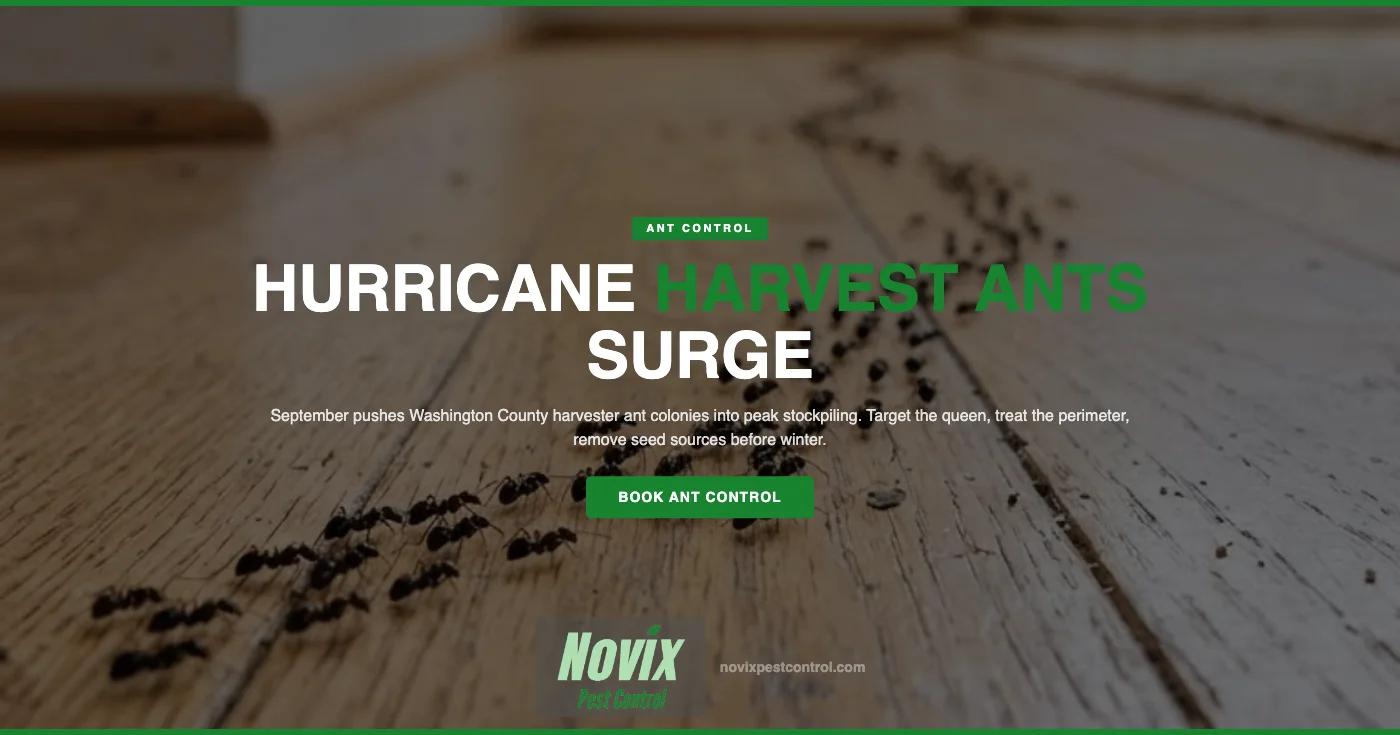
Why Harvest Ants Surge in Hurricane, UT Every September — And How to Control Them
By mid-September in Hurricane, UT, monsoon storms are tapering, overnight lows are settling into the mid 60s, and daytime highs are still pushing 90°F. That combination reads like the end of ant season to most homeowners — in practice, it kicks off the busiest few weeks of the year for harvest ants working the soil under Washington County properties. Late summer and early fall aren't a slowdown for these colonies — they're a stockpiling window before winter dormancy.
If you're spotting large bare-earth mounds along a fence line, watching foraging trails cross a driveway, or noticing more red-brown ants on the patio than you did in July, you're seeing the classic fall pattern every southern Utah pest professional watches for. This guide covers what harvest ants are doing on Hurricane, UT properties this month and how our team at Novix Pest Control handles ant control in Hurricane, UT before the first freeze.
Why Ant Activity Surges in Hurricane, UT Every September
Harvest ants are governed by two things: soil-surface temperature and seed availability. Both variables tilt in the colony's favor between late August and early November across Hurricane, UT.
Peer-reviewed work on Pogonomyrmex occidentalis, the western harvester ant, places worker foraging activity within a surface temperature band of roughly 77°F to 127°F. Hurricane's September afternoons land squarely in the middle of that band — hot enough to keep workers moving, cool enough that they don't retreat underground the way they do during July heat spikes. Overnight lows in the 60s mean the surface soil is still warm at dawn, so the morning foraging shift starts earlier and runs longer than it did at peak summer.
Three additional drivers keep pressure elevated through September and October across Hurricane properties:
Seed availability peaks after monsoon rains. July and August storms produce a flush of grass, forb, and weed seed across desert landscapes. By September, that seed is dry, easy to carry, and lying on open ground within a few dozen feet of most mounds. The September seed drop is the single largest resource pulse of the year for these colonies.
Reproductive alate flights. Mature colonies release winged reproductives — alates — on warm afternoons after a soaking rain. Southern Utah gets a smaller but reliable fall pulse following the last monsoon cells. A cloud of large winged ants over a hilltop, patio, or driveway in September signals that established colonies within about a mile are producing new queens.
Pre-winter stockpiling. Harvest ants don't hibernate — they retreat underground with their seed cache and rely on stored food to support the queen and brood through winter. Workers push seed collection to its annual maximum through September and October to fill those chambers, which is exactly why homeowners see the most surface activity around mounds this month.
The Most Common Ant Species Around Hurricane, UT Homes
Not every ant on a Hurricane property is a harvest ant, and identification matters because treatment differs meaningfully across species. Our technicians see four common groups of ants in and around Hurricane, UT homes.
Western harvester ant (Pogonomyrmex occidentalis). The signature Washington County ant. Workers are large — a quarter to half an inch — with red-brown to deep-red coloration and a tuft of hairs on the underside of the head. Colonies build the conspicuous flat gravel mounds surrounded by a bare-earth clearing three to six feet across. According to AntWiki reference material on the species, a mature colony can hold up to 20,000 workers with a single long-lived queen and can persist on the same site for 20 years or more.
Rough harvester ant (Pogonomyrmex rugosus). A close relative of the western harvester, active across the warmer, lower-elevation portions of southern Utah. Similar sting, similar mound-clearing behavior, slightly larger workers. On Hurricane properties near open desert or transitional grassland, we frequently recover both species from the same acre.
Odorous house ants (Tapinoma sessile). Small dark ants trailing across kitchen counters in irrigated neighborhoods. They release a coconut-like odor when crushed — the fastest field identification. Not stingers; primarily a nuisance issue, but colonies can hold tens of thousands of workers across multiple satellite nests.
Pavement ants (Tetramorium immigrans). Small brown-black ants nesting under driveways, patios, and sidewalk slabs. They sting weakly and rarely represent a structural threat, but they colonize aggressively under any hardscape.
Harvest ants deliver a genuinely painful sting — Pogonomyrmex venom ranks among the most painful of any North American insect on a per-sting basis. Most reactions are localized swelling and burning that resolves within hours. In people with underlying insect-sting allergies, harvest ant stings warrant the same caution as bee or wasp encounters.
Where Harvest Ants Build Colonies on Southern Utah Properties
Harvest ant colonies concentrate where the soil is open, the drainage is fast, and the seed supply is reliable. On Hurricane, UT properties, that translates into a predictable set of trouble zones our technicians walk on every ant control call.
Open desert-adjacent fence lines. Properties backing onto BLM land, wash corridors, or undeveloped lots show the heaviest harvest ant pressure. Colonies establish on the wild side of the fence and forage across into landscaped yards, particularly where drip irrigation puts a moisture edge along the property boundary.
Xeriscape and gravel yards. The pea-gravel and decorative-rock landscaping common across Hurricane provides ideal harvest ant habitat: warm surface temperatures, easy tunneling, no dense vegetation shading the mound. A colony that would take five years to establish under a lawn can set up inside a rock bed in a single season.
Driveway and sidewalk edges. Where a concrete slab meets soil, the transition zone warms faster and stays drier than the surrounding yard, and colonies exploit that microclimate reliably. Mounds along driveway edges and patio slabs are among the most common calls we receive from Hurricane homeowners.
Playground and pool-deck perimeters. Anywhere the family congregates barefoot deserves an inspection during fall pressure. A single harvest ant sting in a play area is enough to push a colony to the top of the priority list.
Underneath shed pads and detached structures. Older sheds and detached garages often sit on compacted soil or a light gravel base that harvest ants readily colonize. We recover mature colonies under decades-old shed pads on ant service calls across Hurricane every fall.
Signs of an Ant Infestation Around Your Hurricane Home
Harvest ants work above ground for hours each day, which makes surface evidence easier to spot than the signs of many other pests. The trick is knowing what to look for before the sting count climbs.
- Bare-earth mounds. The flat-topped gravel mound with a three-to-six-foot cleared radius is the single most diagnostic sign of a harvest ant colony. The cleared zone widens through summer and reaches maximum size in September and October.
- Foraging trails. Look for narrow, well-worn paths of bare soil radiating outward from the mound, sometimes extending 20 to 60 feet into the yard. Workers use these trunk trails for weeks at a time.
- Seed husks near the mound. Harvest ants strip the outer coat off seeds before storing the kernels underground. The discarded husks accumulate in a low ring around the mound entrance — a dense husk ring indicates a mature, productive colony.
- Winged ant flights over open ground. A cluster of large winged ants flying together over a hilltop, patio, or driveway on a warm September afternoon is almost certainly a harvest ant nuptial flight.
- Unexplained stings on ankles and feet. If family members report sudden, sharp stings while walking barefoot in the yard or working near a fence line, harvest ants belong at the top of the diagnostic list. The pain onset is immediate and distinctive.
A single visible mound rarely represents a single colony's full footprint. Mature harvest ant colonies extend tunnels up to 16 feet deep and can maintain feeding chambers well outside the visible mound perimeter. Two or more of the signs above on a Hurricane property in September is a reliable case for scheduling a professional inspection before winter dormancy sets in.
Landscape and Sealing Steps That Reduce Ant Pressure Before Winter
Effective harvest ant management on a Hurricane, UT property pairs targeted treatment with a set of landscape corrections that reduce colony pressure over the long term. These are the steps we walk homeowners through during every ant control service.
Remove seed sources near the structure. Weed heads, grass seed, and fallen ornamental seed inside a 20-foot ring around the house feed harvest ant colonies directly. Cut and bag seed-bearing weeds in late summer before they mature, and blow accumulated seed out of gravel beds along the foundation.
Break foraging trails. The trunk trails workers establish between the mound and productive foraging zones represent weeks of colony investment. Interrupting a trail with a shift in landscape material — a fresh layer of gravel, a swept concrete path, a re-mulched bed — forces the colony to re-route and slows food return.
Seal foundation entry points. While harvest ants primarily nest outside, they will exploit any foundation crack, expansion joint, or utility penetration that gives them access to an air-conditioned kitchen. Caulk gaps around plumbing entries, weep holes, and slab expansion joints with a paintable elastomeric sealant.
Adjust irrigation away from the foundation. Drip emitters positioned within 18 inches of the stem wall create the moisture edge that harvest ant scouts follow into the structure. Move emitters out to the drip line of shrubs and rotate rotor heads so spray falls at least three feet from the foundation.
Rake and level gravel beds quarterly. The flat, undisturbed surface of a decorative gravel bed is prime harvest ant real estate. A quarterly rake pass deters colony establishment without damaging the landscape.
Store firewood and cellulose off the ground. Stacked firewood, leftover framing lumber, and buried construction scrap shelter satellite ant activity. Move firewood at least 20 feet from the structure, elevate it off the soil, and clear any buried debris uncovered during landscape work.
These corrections reduce colony pressure meaningfully, but they don't eliminate a mature colony on their own. Once a harvest ant colony has established beneath a Hurricane property and produced its first alate flight, a targeted professional treatment is the reliable path to full control.
When to Call a Professional Ant Control Service in Hurricane, UT
Homeowner-grade ant baits and contact sprays produce mixed results against harvest ants because the target biology differs from the sugar-feeding kitchen ants those products are designed for. Harvest ant workers carry seed, not sugar solution, and they discard anything that smells foreign near the mound. Standard granular baits often sit untouched next to a mound for weeks.
Our technicians approach harvest ant control as a mapped, colony-level program rather than a spray-and-hope surface treatment. Every service call in Hurricane starts with a full property walk to locate every mound, every trunk trail, and every entry point along the foundation. From there we build a treatment plan around three components:
Direct mound treatment. Active mounds get a targeted application designed to reach the queen and brood chambers below the visible surface. We use products labeled for harvest ants at rates that eliminate the colony without contaminating the surrounding landscape.
Perimeter and structural barrier. The foundation, garage slab, patio perimeter, and any hardscape edge scouts follow inward receives a residual barrier treatment. This keeps foraging workers from the neighboring desert from establishing new mounds against the house during the fall migration window.
Landscape and sealing recommendations. Every property receives a written summary of the corrections we've identified during the walk — seed sources to clear, irrigation to relocate, cracks to seal — so the treatment holds through next season instead of collapsing back to baseline pressure.
Our team serves Hurricane, La Verkin, Washington, St. George, Ivins, and Santa Clara with a 4.8-star reputation across southern Utah. If you're seeing bare-earth mounds, foraging trails across the driveway, or unexplained stings around the yard this fall, reach out and our team will schedule a full inspection and put together a plan tailored to your property. Fall is the highest-value window on the Hurricane ant control calendar — colonies are exposed, workers are on trail, and every treatment placed now pays out across the entire next season.