
Why Cockroaches Surge in Leeds, UT During Late Summer Monsoon Season
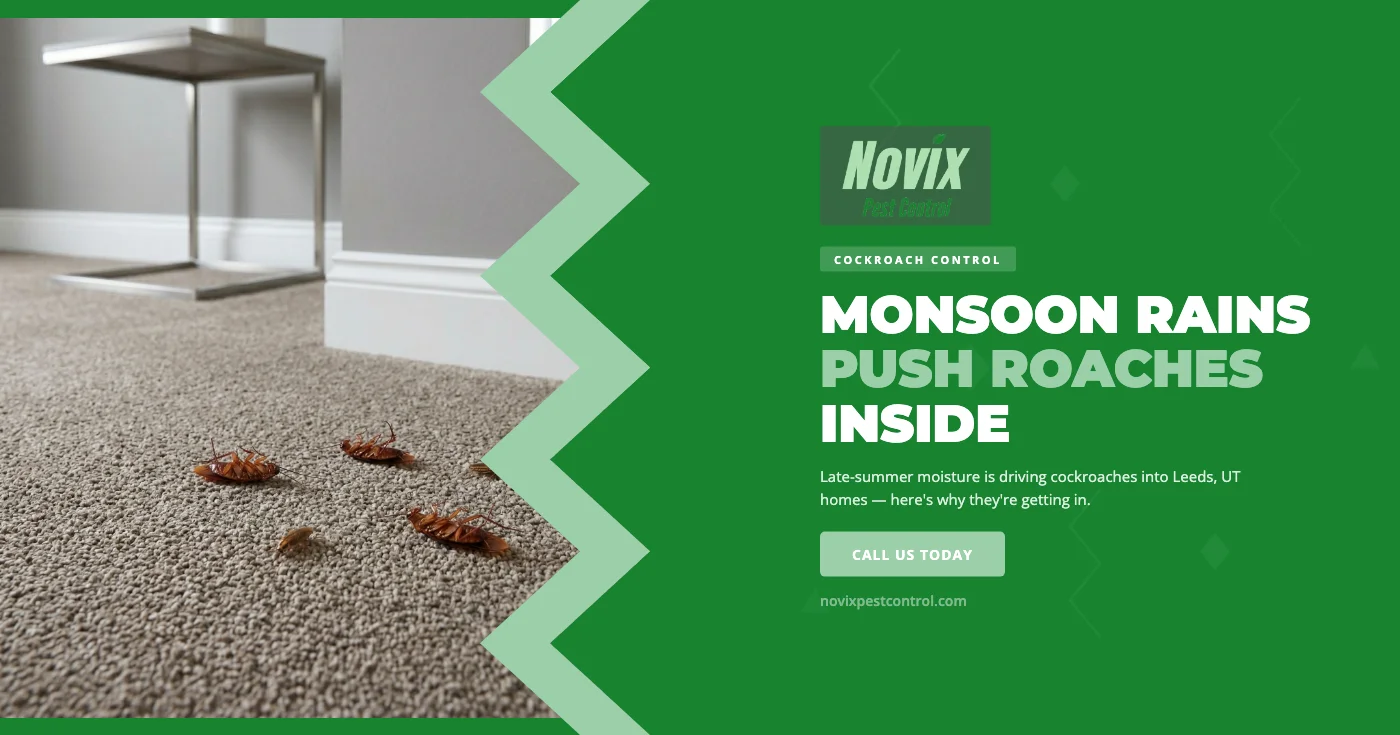
Why Cockroaches Surge in Leeds, UT During Late Summer Monsoon Season
By late August in Leeds, UT, the summer monsoon has changed the character of the desert. Afternoon storms drop inches of rain in an hour, humidity swings that sat in the teens climb into the 50s and 60s, and every drainage swale, irrigation line, and shaded landscape bed holds water that would have evaporated in hours a month earlier. That shift rewrites cockroach behavior across southern Utah — and homeowners in Leeds, La Verkin, Washington, and the broader St. George area start noticing activity that felt absent through May and June.
If you're spotting cockroaches around exterior lights, finding droppings under the kitchen sink, or noticing a musty odor in the garage, you're seeing the seasonal surge every southern Utah exterminator watches for. This guide covers why monsoon season drives cockroaches into Leeds, UT homes, what species you're likely to encounter, and how our team at Novix Pest Control approaches cockroach control in Leeds, UT.
Why Monsoon Season Brings Cockroaches Into Southern Utah Homes
Southern Utah's monsoon season officially runs from June 15 through September 30, but the heaviest activity concentrates between early July and late August — the same window when Leeds, La Verkin, and the surrounding communities see the most concentrated cockroach pressure of the year.
Three drivers stack together to push activity from the surrounding desert into homes and outbuildings.
Moisture where it wasn't before. Cockroaches need water more than food — many species survive a month without eating but only about a week without drinking. Through May and June, southern Utah's low humidity confines populations to reliably moist microhabitats: irrigation boxes, drain lines, water meter vaults, and the shaded voids under decorative rock. Monsoon storms scatter that moisture everywhere. Puddles hold in yards for days, gutters and downspouts stay damp, drainage swales fill and drain repeatedly, and mulch beds trap humidity against the foundation.
Humidity spikes. Cockroaches are ectothermic and lose water through their cuticle faster in dry air. When outdoor relative humidity climbs from single digits into the 40 to 60 percent range monsoon storms push it to, the daily energy cost of survival drops and reproduction accelerates. A single female German cockroach can produce 300 to 400 offspring in her lifetime, and a full generation completes in as little as 45 days under favorable conditions.
Displaced harborage. The same storms that supply water flood the outdoor spaces cockroaches had been sheltering in. Irrigation boxes fill, mulch beds saturate, and wood piles get soaked — pushing populations toward higher-quality shelter, which almost always means the nearest structure. That's why Leeds homeowners typically see the first indoor sightings within a few days of a heavy monsoon cell rather than during the storm itself.
Common Cockroach Species Found Around Leeds, UT
Four cockroach species commonly appear in Utah, and the mix around Leeds has been shifting over the past decade. Identifying which species you're seeing shapes the treatment plan — different species harbor in different parts of the property and respond to different bait formulations. Utah State University Extension lists German, American, oriental, and brown-banded cockroaches as the historical Utah mix, but the field has been reshaped by an arrival from Central Asia.
Turkestan cockroach (Blatta lateralis) is the dominant peridomestic species across the desert Southwest and increasingly the one our technicians encounter first on Leeds and greater St. George properties. Native to Central Asia and the Middle East, the Turkestan cockroach has been steadily displacing the oriental cockroach across California, Arizona, New Mexico, and much of Utah. Adult females are about an inch long, dark brown to black with cream-colored markings on the pronotum. Males are smaller, reddish-brown to orange with yellowish wings that extend past the abdomen — and males are strong fliers, unusual among peridomestic roaches. Turkestans thrive in irrigation boxes, meter vaults, drain lines, and the moist voids under decorative rock and mulch, reproducing faster than orientals and tolerating dry conditions better.
German cockroach (Blattella germanica) is the classic indoor kitchen roach — small (about half an inch long), light brown with two dark stripes running down the pronotum. Germans do not typically thrive outdoors in southern Utah's climate and almost always arrive as hitchhikers on cardboard, appliances, groceries, or used furniture. Once established, they multiply quickly in warm, humid areas — kitchens, bathrooms, and appliance motors — and are the species most likely to trigger a serious indoor infestation.
American cockroach (Periplaneta americana) is the largest species in Utah, running one and a half to two inches long and reddish-brown with a light yellow band along the pronotum edge. Americans favor warm, humid environments — sewer systems, boiler rooms, drain lines, and commercial kitchens — and occasionally push into residential garages, laundry rooms, and basements during monsoon flooding of the storm and sewer systems.
Oriental cockroach (Blatta orientalis) is still present but declining in the Leeds area as Turkestans take over its niche. Orientals are shiny black, about an inch long, and prefer cool, damp spaces — basements, crawl spaces, cellars, and the underside of stone or concrete features.
How Cockroaches Get Into Your Home During Rainy Periods
Monsoon storms don't just create favorable conditions — they physically move cockroaches. Sheet flow across landscape beds, backed-up drainage, and pressurized runoff through irrigation systems all shove populations toward the foundation, where they exploit the same handful of entry categories on almost every Leeds property.
- Garage door seals. Weathered rubber sweeps at the corners are the single most common entry we see. Turkestan males, in particular, fly to exterior lights and walk under the seal during summer evenings.
- Weep holes and foundation gaps. Weep holes in stucco and small foundation cracks let cockroaches move directly into wall voids.
- Utility penetrations. Openings around gas lines, water supply lines, cable, and electrical conduits are rarely fully sealed by original construction and are a reliable indoor entry.
- Door thresholds and weather stripping. Aging thresholds on exterior doors, especially into laundry rooms and garages, leave enough of a gap for a Turkestan or oriental to walk under.
- Plumbing penetrations under sinks and behind toilets. Interior wall voids connect to exterior harborage through any unsealed penetration where copper or PEX enters the wall.
- Dryer vents and exhaust vents. Missing or broken flapper covers give both roaches and rodents direct interior access.
- Hitchhiking material. Cardboard boxes stored in a damp garage, used appliances, and grocery bags left in a moist area are the most common German cockroach entry — a single ootheca (egg case) contains 30 to 40 nymphs.
Signs You Have a Cockroach Infestation in Your Leeds, UT Home
Cockroaches are nocturnal, so a full-daylight sighting is meaningful — it typically means the harborage is crowded enough to push individuals into the open. But most infestations announce themselves more subtly first, and catching them early keeps the treatment short.
- Droppings. German droppings resemble coarse ground coffee and accumulate in cabinet corners, drawer tracks, and along shelf edges. Larger species — Turkestan, American, oriental — leave rice-grain-sized pellet droppings in garages, along the foundation exterior, and inside irrigation boxes.
- Musty odor. Established populations produce a distinctive musty, oily smell often compared to a damp basement. If you can smell it in a kitchen, laundry room, or garage, the population is well past a single individual.
- Egg cases (oothecae). Purse-shaped, dark brown capsules about a quarter inch long. German cockroach females carry the ootheca until just before hatching, so finding cases in cracks and crevices means active reproduction on the property.
- Shed skins. Cockroaches molt five to seven times before adulthood, leaving translucent exoskeletons behind. Finding shed skins in cabinets or behind appliances confirms a resident population.
- Damaged food packaging. Chewed cardboard, small holes in paper packaging, or fouled dry goods indicate pantry access.
- Live sightings at dawn or dusk. Cockroaches active at first or last light — around exterior lights, under kitchen sinks, or on a garage floor — mark the peak of their nightly activity.
Two or more of these clustered in the same area almost always means an active nest within about 20 feet. Beyond the damage, cockroach droppings and shed body parts are documented asthma and allergy triggers — per the EPA, cockroach allergens are among the most significant indoor asthma triggers in the U.S., especially for children.
Prevention Tips to Keep Cockroaches Out This Monsoon Season
Prevention in a monsoon-driven desert climate breaks into three categories: eliminate the moisture and food that draws cockroaches in, seal the openings they use to enter, and reduce outdoor harborage against the property.
Manage moisture:
- Repair leaking hose bibs, drip line fittings, and irrigation valves within a day of noticing them.
- Redirect roof runoff and monsoon storm flow away from the foundation with functional gutters and downspout extensions.
- Drain evaporative-cooler condensate lines to a location well away from the foundation.
- Fix leaking faucets, dishwasher connections, and water lines under sinks — even a slow drip supplies enough moisture for a cockroach population.
Manage food:
- Store pantry staples — flour, cereal, pet food, dry goods — in sealed glass or heavy plastic containers.
- Wipe down counters, sweep floors, and clean stovetops nightly during monsoon season.
- Empty and rinse kitchen trash daily, and keep exterior bins with tight-fitting lids at least a few feet from the house.
- Do not leave pet food out overnight, especially in a garage or laundry room.
Seal entry points:
- Replace worn garage door seals — the corners fail first and are worth checking every spring.
- Install door sweeps and fresh weather stripping on all exterior doors, including the garage-to-house door.
- Caulk gaps around utility penetrations, foundation cracks larger than a credit card's thickness, and window frames.
- Cover weep holes with fine mesh screen or dedicated weep hole covers that allow drainage without cockroach access.
Reduce outdoor harborage:
- Keep firewood, scrap lumber, and stored building materials at least 20 feet from the exterior wall.
- Pull back mulch and decorative rock to leave an 18-inch gap between landscape material and the foundation.
- Trim ornamental plantings so they do not touch the exterior wall.
- Inspect and clean irrigation boxes, meter vaults, and drainage swales twice through the monsoon season.
When to Call a Professional Cockroach Exterminator in Leeds, UT
DIY treatment can hold a small, newly-arrived population in check when moisture and entry points are addressed at the same time. But there are clear thresholds where a professional plan produces a faster, more reliable result — and a few conditions where over-the-counter products actively make the situation worse by pushing cockroaches deeper into wall voids where they continue to reproduce out of reach.
Reach out to a professional cockroach exterminator when you notice:
- Cockroaches active during daylight hours, particularly indoors.
- A persistent musty odor in the kitchen, laundry, or garage.
- Multiple oothecae or shed skins in a single area.
- Recurring sightings after DIY sprays — a strong indicator that repellent products have scattered the population deeper into wall voids.
- German cockroaches confirmed indoors — this species reproduces too quickly and resists over-the-counter pesticides too effectively for consumer products to reliably control.
At Novix Pest Control, our licensed technicians handle cockroach control in Leeds, UT as a three-part program. First, we walk the full property — interior, exterior, garage, outbuildings, and irrigation infrastructure — to identify the species, locate active harborage, and map entry points. Second, we apply species-appropriate treatment: gel baits placed in cracks and crevices for German cockroaches, targeted perimeter treatment around Turkestan and oriental harborage, and non-repellent products that keep populations from scattering deeper into the structure. Third, we address the moisture and structural conditions that drew the population in — because treatment alone simply resets the clock until the next monsoon storm.
Our team serves Leeds, La Verkin, Washington, Ivins, Santa Clara, and the greater St. George area with a 4.8-star reputation across southern Utah. If you're seeing droppings under the sink, smelling that musty odor in the garage, or spotting Turkestan cockroaches around exterior lights this monsoon season, reach out to schedule an inspection and we'll put together a plan tailored to your Leeds property.