
Why Fire Ants and Harvester Ants Invade Washington, UT Yards in Spring | Novix Pest Control
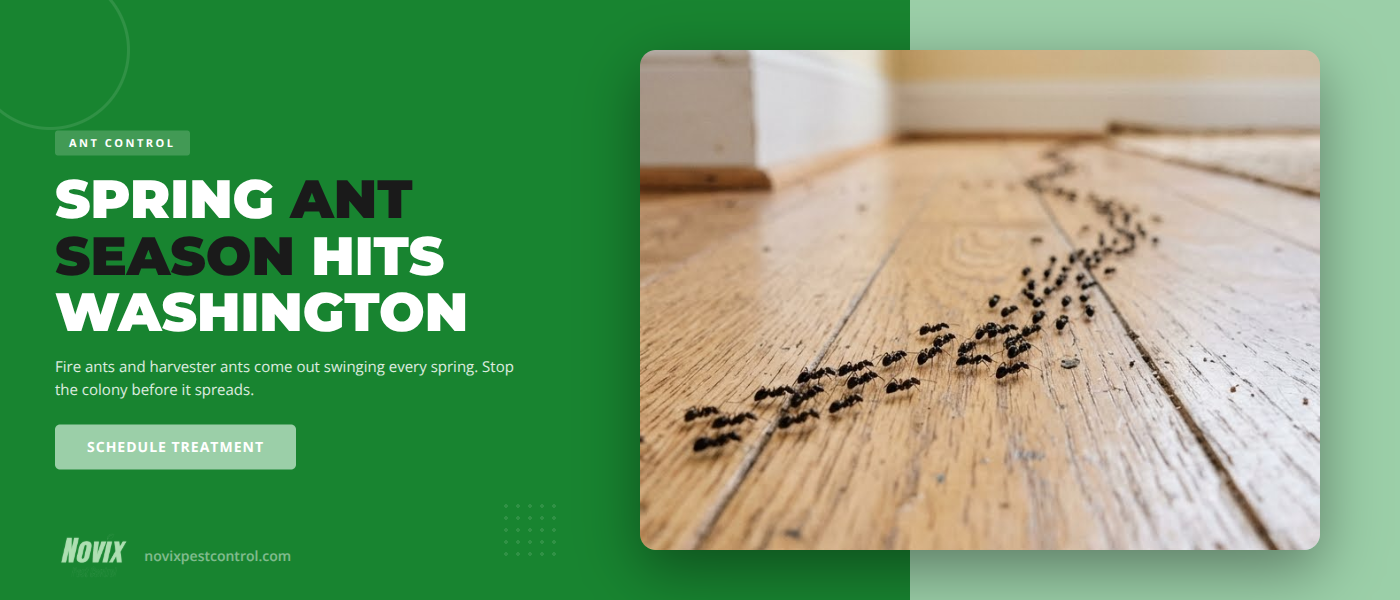
Why Fire Ants and Harvester Ants Invade Washington, UT Yards in Spring | Novix Pest Control
Spring in Washington, UT brings warm afternoons, blooming desert plants, and a familiar problem across Washington County — ants. Once soil temperatures climb past the 50s, colonies that were quiet all winter come back to life, and bare-dirt circles in your yard fill with red ants on the move. For many residents, that's the first sign another season of ant control in Washington, UT has started.
Two species drive most of the spring complaints: harvester ants — the large red ants that build cleared disk mounds in desert yards — and southern fire ants, the smaller, more aggressive species that turns up in irrigated landscaping. Both can sting, and both thrive on local conditions. Below, we'll cover when spring ant season really starts, how to tell the two apart, and how our team at Novix Pest Control handles ant problems at the colony level.
Why Spring Triggers Ant Activity in Washington, UT
Ant colonies in southern Utah don't disappear in winter — they slow down. Workers retreat into the nest, egg production drops, and surface activity nearly stops. Spring reverses it: soil warms, foragers return, egg-laying ramps back up, and colonies shift into expansion mode almost overnight.
Washington warms earlier than most of the country — daytime highs routinely hit the 70s by late March — so ant pressure shows up weeks before homeowners elsewhere in Utah notice it. By the time you spot mounds or workers on the counter, the colony has been active for a while.
Spring is also when many species send winged reproductives out for nuptial flights — new queens land, mate, and start fresh colonies, so a property with two harvester mounds last fall can easily pick up a third or fourth this spring. Irrigation amplifies it: drip lines and sprinklers reactivate the damp soil ants love. Combined with warming temperatures, conditions for a spring ant invasion in Washington, Utah are as favorable as they get.
Fire Ants vs. Harvester Ants: How to Tell Them Apart
One of the most common questions we get is some version of, "Are these fire ants?" The bright red ants most often seen in yards across southern Utah are typically harvester ants (Pogonomyrmex species) — not the imported red fire ants people picture from news coverage in the Southeast.
According to Utah State University Extension, the imported red fire ant (Solenopsis invicta) is not established in Utah — though Washington, Iron, and Kane counties have conditions that could support it. What does occur naturally across the desert Southwest is the southern fire ant (Solenopsis xyloni) — a smaller, less aggressive native cousin, but still capable of a painful sting and willing to nest near homes.
- Harvester ants: Large (1/4 to 3/8 inch), bright red to reddish-brown, with a bare-soil "disk" mound a foot or more across — vegetation cleared away in a wide ring around a single entrance.
- Southern fire ants: Smaller (1/8 to 1/4 inch), two-toned (reddish head and thorax, darker abdomen), with looser mounds along driveways, sidewalk cracks, irrigation lines, and lawn edges.
- Sting behavior: Harvester ants sting mainly when disturbed, but the sting is among the most painful of any North American ant. Southern fire ants are quicker to swarm and sting in groups, which makes them a particular concern around children and pets.
If you're not sure what you're looking at, a few clear photos and a mound description are usually enough for our team to identify it. If it really looks like an imported fire ant, contact the Utah Plant Pest Diagnostic Lab.
Where Ants Build Colonies Around Washington Homes
Ant nesting in Washington is shaped almost entirely by sun, soil, and moisture. Both species prefer sunny, well-drained ground — exactly what most yards here offer. Common spots:
- Open patches of bare soil (classic harvester ant territory)
- Edges of driveways, sidewalks, and patios where concrete radiates heat
- Cracks in retaining walls, block walls, and decorative rock features
- Along irrigation drip lines and lawn perimeters
- Beneath flagstone, pavers, and landscape rocks
- Near foundations on the south- and west-facing sides of the home
When ants come indoors — more often southern fire ants — they follow utility penetrations, slab expansion joints, weep holes, and gaps under exterior doors. Kitchens, pantries, and pet feeding stations are common trouble spots once a trail is established.
Per the Great Basin Fire Science Exchange, those cleared harvester disks aren't random — workers actively remove vegetation and seeds in a wide ring around the entrance, sometimes harvesting 60 feet away or more.
Sting Risk: Why Fire Ants Are More Than a Nuisance
Most ant species in Utah are mainly an annoyance. Harvester ants and fire ants are different — their stings are painful enough that we treat them as a household well-being issue, not a routine nuisance.
Harvester ant venom produces intense, burning pain that can radiate from the sting site and last for hours. Multiple stings — easy to collect by stepping on a mound — leave welts for days. True allergic reactions are uncommon, but any swelling beyond the local area, hives, dizziness, or trouble breathing should be treated as a medical emergency.
Southern fire ants are smaller but tend to sting in groups when a nest is disturbed, sometimes leaving small pustules a day or two later. A few stings are manageable for healthy adults. For young children, elderly family members, and pets — particularly dogs that nose into nests — even a moderate number can be a serious concern.
How Desert Landscaping in Washington, UT Affects Ant Pressure
The same landscaping choices that make a Washington yard look great in 105-degree heat also make excellent ant habitat. Desert-adapted ants evolved alongside these conditions — which is why some properties see steady year-after-year pressure while others a few houses down deal with it only occasionally.
- Bare gravel and decomposed granite: Loose, sun-warmed material drains well and is easy to tunnel into — ideal for both species.
- Block walls and retaining walls: Voids inside block courses and gaps along footings give colonies protected nesting space.
- Flagstone, pavers, and boulders: The undersides hold moisture and warmth — some of the most consistent nest sites we find on Washington properties.
- Drip irrigation: Reliable moisture in a dry environment is a magnet for foragers and helps colonies expand quickly.
- Lawn-to-rockscape transitions: The boundary between turf and gravel creates a microclimate southern fire ants exploit.
None of this means tearing out your landscaping — it just means effective ant management has to account for these features. When we walk a Washington property, the landscape design tells us a lot about where colonies are and how they're moving.
DIY Ant Tactics That Don't Last (and Why)
Hardware-store ant products have their place, but almost none eliminate a harvester ant or southern fire ant colony on their own. Here's what we typically see:
- Contact sprays kill foragers, not colonies. A spray along a trail knocks down the workers you see, but the queen and the rest of the colony are below the surface and untouched.
- Wrong bait, wrong species. Harvester ants are seed eaters; off-the-shelf protein and sugar baits don't match. Southern fire ants accept more bait types, but bait not formulated for desert conditions dries out fast.
- Mound drenches can scatter colonies. A generic insecticide poured into a mound often kills surface workers and triggers the rest to relocate — often to a different part of the same yard.
- One-and-done timing. A single May application rarely holds through October. The desert keeps producing new pressure all season, especially after monsoon storms and warm-weather flights.
DIY can knock down visible activity for a week or two but doesn't change underlying pressure. For lasting reduction with stinging species, professional treatment paired with smart property habits is more reliable.
How Novix Pest Control Eliminates Ant Colonies at the Source
At Novix Pest Control, our approach to ant control in Washington, UT is built around the species we actually see, the desert conditions that drive their behavior, and the construction details common in Washington County homes. Rather than spraying what's visible and hoping for the best, we treat ant problems as colony problems and work them from the source. A typical ant pest control visit includes:
- Property-wide inspection for active mounds, foraging trails, harborage zones, and the structural details ants use to enter the home.
- Targeted mound treatment using products designed to be carried back into the colony, not just kill workers on the surface.
- Bait matched to the species. Harvester ant bait isn't the same as southern fire ant bait — matching food source to species is one of the biggest factors in lasting results.
- Perimeter and entry-point treatment on foundations, expansion joints, weep holes, utility penetrations, and door thresholds.
Because ant pressure here doesn't shut off after one visit, we offer ongoing treatment plans that keep properties protected through peak season. Recurring service prevents re-establishment and lets us catch fresh mounds before they become a real problem. We serve Washington, St. George, Santa Clara, Ivins, Leeds, and surrounding communities with a 4.8-star rating across the region.
Frequently Asked Questions About Spring Ants in Washington, UT
Are there fire ants in Washington, UT?
The aggressive imported red fire ant (Solenopsis invicta) is not established in Utah. The native southern fire ant (Solenopsis xyloni) does occur in southwestern desert areas and occasionally turns up around Washington homes, particularly in irrigated landscaping. Most of the bright red, painful "fire ants" people report here are actually harvester ants in southern Utah, which deliver one of the most painful stings of any ant in the state.
How do I know if a mound in my yard is a harvester ant nest?
Harvester ant mounds are distinctive: a circular area of bare soil — often a foot or more across — with vegetation cleared away and a single entrance hole, typically peppered with small gravel and seed husks. Large red ants streaming in and out on a sunny spring day is almost always a harvester colony.
When does ant season start in Washington, UT?
Ant activity here usually picks up in March as soil temperatures warm and irrigation systems come back online. Peak pressure runs April through October. Treating early in the season is one of the most effective ways to keep populations from spiking later.
Are harvester ant stings dangerous?
They're not usually medically serious for healthy adults, but they're extremely painful and can leave welts for days. Stings on young children, elderly family members, or pets should be taken more seriously. Spreading hives, dizziness, or trouble breathing should be treated as a medical emergency.
How often should I get professional ant control in Washington, UT?
For most properties, recurring service every two to three months through the warm season is the best balance of cost and consistent results. Homes backing up to undeveloped desert or with active stinging-ant pressure usually benefit from a more frequent schedule.
Get Ahead of Spring Ant Season in Washington, UT
Spring ant pressure here isn't a once-and-done problem — it's an annual rhythm tied to the desert climate and Washington County landscaping. Harvester ants keep building disk mounds in sunny yards, southern fire ants keep finding irrigated planters, and the homes that stay ahead treat colony management as part of normal property care.
The most effective approach combines species-matched professional treatment with smart habits: addressing irrigation overspray, keeping clutter away from the foundation, sealing obvious entry points, and dealing with mounds as they appear.
Novix Pest Control brings deep local experience to ant control in Washington, UT. We know the species, how desert conditions drive their behavior, and how to treat for lasting results. If you're seeing mounds, foragers, or fresh activity around your home this spring, reach out and we'll put together a plan tailored to your property — and get you ahead of the season before encounters move from the yard into the house.